
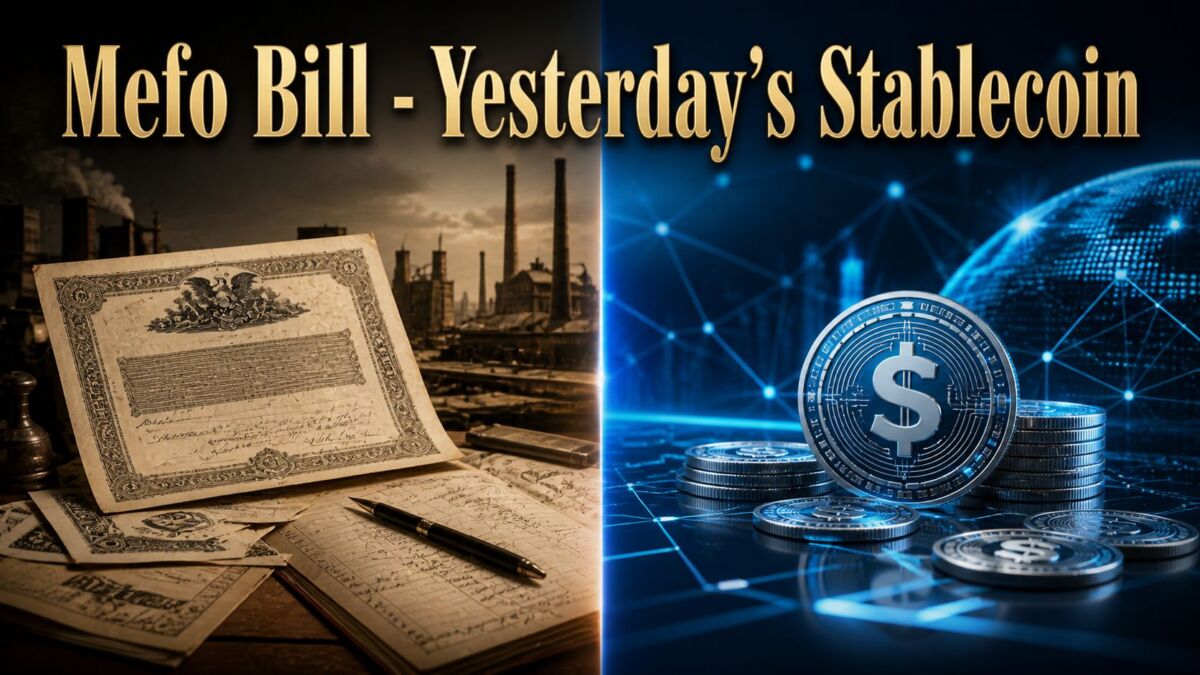
Mefo Bill – Yesterday’s Stablecoin – The Washington Normal
Most likely, few have wondered how Germany was able to build a war machine during the 1930’s, especially when reparation payments from WWI broke its economy and sent millions into unemployment. But the story is actually quite fascinating.
Hitler, in cahoots with German’s central bank president, Hjalmar Schacht, built a parallel fake currency to fund his army. Schacht created a fake front company, Metallurgical Research Corporation, that issued promissory notes, called a Mefo bill, which was tied to Germany’s currency, the Reichsmark. German armament companies would obtain these Mefo bills from the fake company, then exchange them at any bank for Reichsmarks. The bank then turned the bills over to Germany’s central bank, the Reichsbank.
Since the Mefo bills were through a fake private company, the transactions were left off of government balance sheets. This allowed the government to run a larger deficit and hide the debt it was creating. The scheme gave the Reich the ability to build credit under the central bank that funded the war, often with money that was stolen from Jewish citizens and businesses. With this fake parallel currency, and in spite of the Treaty of Versailles banning it, the rearmament of Germany began.
Get Daily Emails
Mefo bills were backed by nothing except a promise note, like what exists today with fiat money. This was a fake economic system and a great way to hide the fact that an army was being built.
Understanding Mefo bills in Germany may help explain what is happening similarly right here in America with stablecoins, which are not issued as a currency by the government, but rather by the private sector. There is also the parallel that these digital currencies are being used to build a parallel economic system, albeit not as secretly as the Mefo scam. Perhaps the most perilous issue with stablecoins is that they “must continually strengthen the “circulation value“. In other words, they must reduce users’ incentive to redeem them for fiat currency.”
Great care has been taken by the Trump administration to create a “digital representation of value that is recorded on a distributed ledger, including cryptocurrencies, digital tokens, and stablecoins.” Unlike the Mefo bill that could be held in the hand, a stablecoin is something of value that can’t be physically held. It is just on a digital ledger. But it is a digital asset that can be used as an exchange for something else of value, a cute way that avoids saying it can be used as currency or money.
Like the Mefo being tied to the fiat Reichsmark, most stablecoins are tied to the fiat U.S. dollar, which is not backed by a physical commodity like gold or silver. After approval, payment stablecoins are issued by private companies as tokens on a blockchain, which also serves as the ledger for transactions, and, like the Mefo bill, are separate from the federal government balance sheet, even though pegged to the U.S. dollar. A separate financial system is being built with this technology.
This “digital representation of value” was created in spite of Article I, Section 8, Clause 5 in the Constitution, which states only Congress has the authority to coin money and regulate its value. “…stablecoins are not officially legal tender“.
In 2024, President Trump and Steve Witkoff, with their sons and others, founded World Liberty Financial (WLFI), a decentralized finance (DeFi) company. After taking office, President Trump was then listed as a “co-Founder Emeritus“. A DeFi is a “financial system that uses blockchain technology and cryptocurrencies to enable direct transactions between individuals and businesses, often without the need for traditional intermediaries such as banks.” It is the parallel financial system being built separate from our traditional banking system, similar to the Mefo bill being a separate financial system. There is also questionable transparency about all WLFI dealings and who is involved. American Bitcoin is another Trump family crypto mining venture.
In March 2025, WLFI launched its own stablecoin called USD1, “a fiat-backed stablecoin that holds a portion of its cash reserves in US government treasuries similar to that of USDC (a U.S. dollar-backed stablecoin), and USDT (Tether)”. USD1 reserves are “held by the digital asset custodian, BitGo, with its reserves primarily held in short-term US government treasuries“.
DeFI creates the digital interoperability for the WLFI stablecoin USD1. Like other stablecoins, USD1 can be converted between digital assets and other currencies, including transactions across borders that can be used by foreign investors, in which WLFI has been engaged. The World Economic Forum likes that idea.
Much like the MEFO bill that was issued instead of cash, the Stablecoin can be used “to increase the usage of the US dollar digitally as the world’s reserve currency”, and potentially create “trillions of dollars of demand for US Treasuries”. (At least this provides some acknowledgment it is an unconstitutional currency that is not issued by the federal government.) The aim is to “cement US dollar’s supremacy in a digital age”, “help fund the federal government” and “lead a new era of “digital finance”. In this scheme, “conventional bank deposits” could be partially replaced or completely bypass the need for a bank account, using blockchain instead.
The Presidential Working Group on Digital Asset Markets offered some recommendations on digital currency uses, just as if it was legitimate, congressionally authorized, money needing regulation on its value.
Since the Mefo was backed by a fraudulent scheme, when it came time to pay up, the added debt it caused was exposed. Stablecoins are not foolproof and even the USD1 is vulnerable to several risks. Concern has been expressed about the effect these stablecoins could have on the economy, given the amount of debt they hold. Surprisingly, even the Bank of International Settlements (BIS) and others warn against the fake use of Stablecoins and which can be frozen or used to block transactions, just like the threat of Central Bank Digital Currencies (CBDC), an activity in which WLFI has already been accused.
Perhaps the broader scheme is the intention to “transform the financial world” and “overtake banks,” as revealed by Eric Trump. As Patrick Wood noted in his article, Trump Family Is Jockeying To Replace The Dollar Globally As Their Wealth Soars, “World Liberty Financial is not just issuing a stablecoin — it is building a full-stack programmable financial infrastructure with Real-World Asset (RWA) tokenization at its core.” This is validated in the embedded video where Zach Witkoff announces WLFI is exploring tokenizing other assets such as oil and timber. And why not? The Trump family has allegedly accrued massive amounts of wealth from this venture while also taking losses. This article re-emphasizes the threat: “Tokenization allows the creation of a new financial system.”
Tokenizing assets is just another World Economic Forum dream being fulfilled. It is all part of the digital transformation that is underway, potentially leading to full control. Just imagine that property deed as a token, the online infrastructure crashes or is hacked, leaving no way to prove ownership of that property. Or maybe someone decides the owner’s behavior is unacceptable and just flips a switch that blocks access, just as was done by WLFT. Rather than forcing compliance through CBDCs, it will be done by the private sector through tokenization.
Eric Trump complained about being cancelled and his stablecoin being “retribution”. Somebody better wake this kid up. Digital currency on a blockchain can also be exploited just as his WLFI allegedly blocked one of its users.
As explained here by Patrick Wood, “Every asset tokenized can be frozen, taxed, transferred, or cancelled by whoever administers the protocol.” He continues to say that U.S. debt does not get paid with this scheme, “It gets restructured into a new architecture and hidden inside a technological layer most people will never examine, until it is too late to escape.”
Heck, even Russia understands the value of creating its own Mefo-style crypto twin for financial survival. Russia has been working on a crypto currency for a few years and using it much like the way the Mefo bill was used, getting around economy killing sanctions, and potentially using it as a way “to hide its armament campaigns.”
The G20, and others, are also working on forcing the world to transform into a digital economy. Just as the World Economic Forum predicted, it is the Great Reset, forever changing everyone’s way of life, forcing all into a digital world. Once this full financial system is achieved, there will be no remnants of life as we know it today because this digital financial world will bring digital ID with it. There will be no escape from surveillance once that happens. Proof of digital ID will be demanded to engage in any life activity. All of this is closer than anyone understands.