
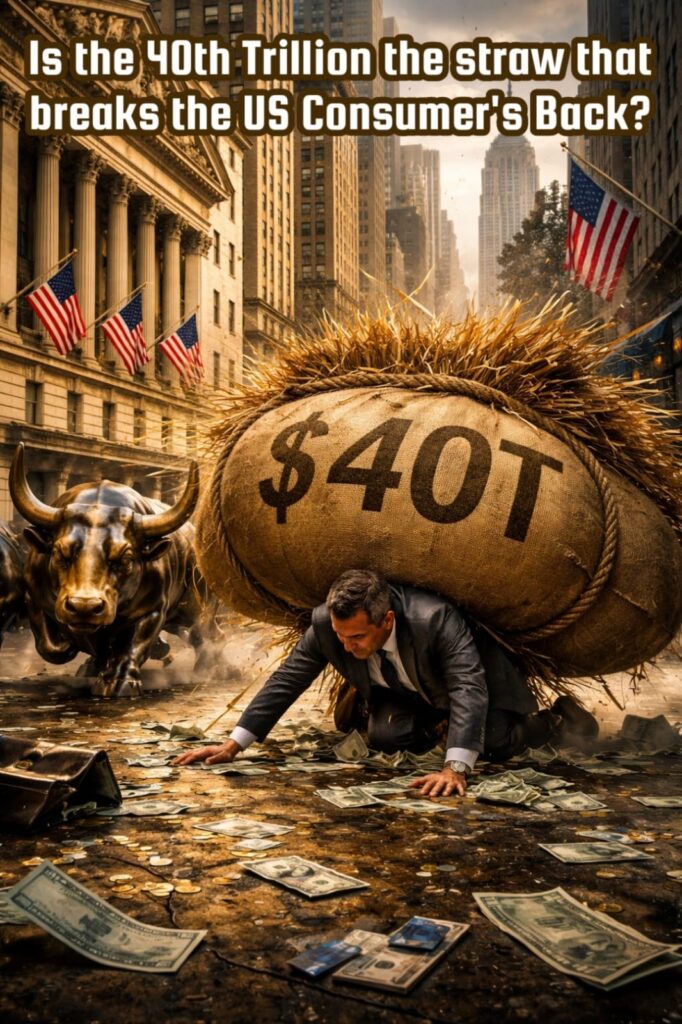
Is the fortieth Trillion the Straw that breaks the US Shopper’s Again?
/script type=”text/javascript” src=”https://app.getresponse.com/view_webform_v2.js?u=S6bT5&webforms_id=A25R”>
Probably. Read On.
The summer of 2026 (June – August) promises to be one for the history books. The events ahead could easily rival those of Oct 1929 – a stock market crash, which was followed by more than 15 years of economic stagnation and a decline in living standards. This extended period from 1929 to 1946 is what we now refer to as “the Great Depression”. This summer could well herald the onset of “The Greater Depression,” and with essential ingredients in place, all that we need is a trigger – or more appropriately, a pin.
The US summer ahead will witness a confluence of several negative factors – each of which, on its own, would threaten the debt-laden US economy. The combination will be the quicksand from which the US Dollar will struggle to extricate itself and probably never meaningfully recover.
I. The US National Debt
$40 trillion, alluded to in the title, is still a few months away. At the time of this writing, US debt is just a shade above $39 trillion and is racing towards $40 trillion, likely to be hit by June 2026. One doesn’t have to be a Buffett to realize that a 5% interest rate on this $40 trillion would yield an annualized interest expense of $2 trillion – nearly 40% of US Federal revenues. That is as bankrupt as a country can be. So, how does the US dollar and the economy appear to be relatively stable against such insurmountable odds?

That is only because the average interest rate on the National debt has a 3-handle at this point. And the 3-handle is only because of the decade of ZIRP that preceded 2022. Now that substantive portions of the maturing national debt and the annual additions in the form of fiscal deficits (to the tune of $10 trillion per year in combination) are to be financed at much higher rates, how long will it be before we hit the 5-handle on the interest rate to be paid on the National debt?
And that brings us to the crucial question: What will cause interest rates on marginal treasury issuances to rise? The obvious answer is an increase in Price Inflation. And as we shall see, that is just around the corner.
II. The Coming Summer Spike in Price Inflation
The trend of high Producer Price Index began in 2026, even before the war started. The Core PPI for Jan and Feb 2026 came in at 0.7% and 0.8%. These are monthly numbers, and annualizing the Feb number would put the core PPI at over 10%. The war in Iran, which started in March, has caused crude oil prices to nearly double and is already causing severe shortages of natural gas and fertilizers, which will cause food and energy prices to skyrocket across the globe.
Despite a temporary strengthening of the US Dollar (as evidenced by the DXY crossing 100), the US is likely to report high single-digit consumer price inflation later this year. While we might be misled into thinking that, once the war ends, prices could return to their normal levels, we should account for the fact that the damage to the energy infrastructure is hardly temporary and could take years to restore. So, energy prices are likely to remain high for the foreseeable future.
This is without accounting for an artificial high in the DXY due to the misplaced-confidence sell-gold-buy-dollar trade. But remember that the US will continue to run trade deficits of more than $500 billion and fiscal deficits of $2 to $2.5 trillion. Therefore, any strengthening of the US Dollar is likely to be temporary, causing the price inflation to spike further.
But perhaps the clearest indicator of the coming spike in price inflation came from the US Import/Export Price Index. U.S. import prices recorded a monthly increase of 1.3%, and export prices increased 1.5%. Annualizing these numbers would make the increase well over 15% for the import prices and almost 20% for the export prices.
Now for the translation of these numbers into CPI – the translation of PPI, as well as import/export prices into the CPI, usually takes between 1 and 6 months. And if the trend persists, as it is likely to, we will have a full-blown price-inflation crisis this summer. Whether this decade’s peak of 9.1% recorded in June 2022 is taken out this year remains to be seen. But we are going to hover pretty close to that number.
In the face of galloping price inflation, is the Fed going to stand pat with its earlier failed “transitory” narrative? Or would it attempt to put up a semblance of a fight with marginal hikes? Either of those paths wouldn’t make a material difference to the outcomes, though the former path would make the bad situation worse.
III. Bubbles and the Pins
While this is the most obvious, at least when viewed from the lens of Austrian Economics, given the multitude of pins and the even greater spectre of bubbles, picking the bubble-pin combination is going to be very hard.
Bubbles : Private credit, Housing prices, AI infrastructure spending/stock valuations, and dollar-denominated bonds, especially the long-maturity ones.
Pins : price inflation, increasing interest rates, US recession, high energy prices, Unemployment, QE restart
The bubbles are lined up one after another, and we might well witness a domino effect when one of them bursts. Viewed from that perspective, the specific bubble-pin combination really doesn’t matter.
The End Game for the US Dollar
We are slowly inching towards the endgame for the US Dollar, and this Iran war might well be the start of that terminal downward spiral. This outcome was unquestionably cast in stone in either 1913 (the formation of the US Fed) or 1971 (the closure of the gold window), and though it has taken time to play out, there is no escaping the consequences of Central Banking or a fiat currency system as implied by those starting years.
The initial market reaction, as we have seen in the DXY strengthening, might well be the typical head fake we witness as part of a longer-term trend. It will bottom out in the next few weeks, and what lies beyond is the reality of The Greater Depression – plunging employment, a deep recession, and roaring price inflation.
About the Author
Shanmuganathan N (aka Shan) is an Economist based in India and can be contacted at shan@plus43capital.com