
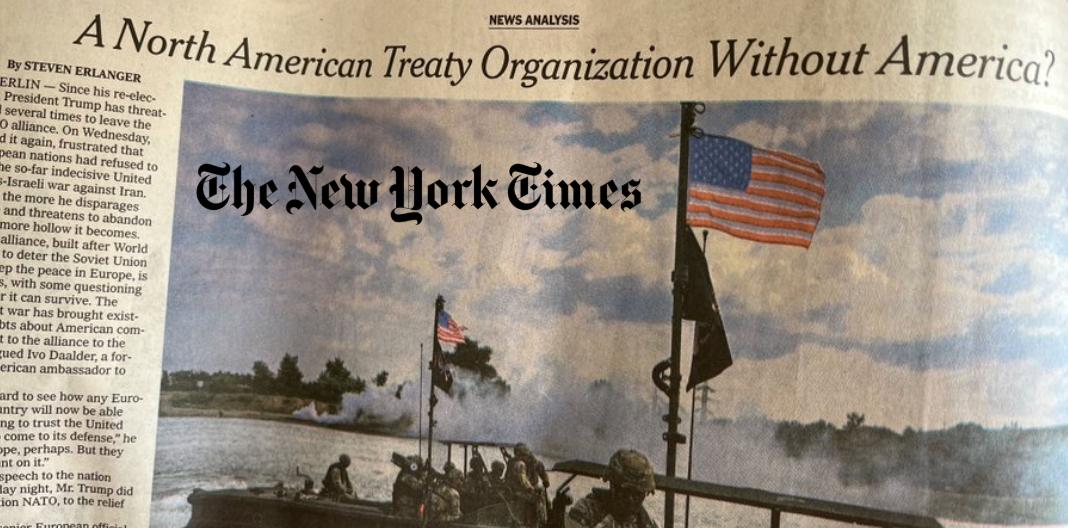
NYT points correction after getting the definition of NATO incorrect
The New York Times delved into the conversation over whether or not the United States should remain in NATO, but in so doing, they stated that the entiry was actually the North American Treaty Organization. It is not. NATO stands for the North Atlantic Treaty Organization.
“A North American Treaty Organization Without America?” Read the page-spanning headline in the International Section on Friday. The article, by Chief Diplomatic Correspondent for Europe Steven Erlanger, delves into the relationship between the United States under President Donald Trump and her European allies, saying that every time Trump threatens to abandon the organization, it becomes hollowed out.
Erlanger did not write the headline, and made that clear in a post on X. “Reporters don’t write print headlines but it was quickly corrected, btw,” he said in reply to a post from University of Virginia’s Charles Mathewes that called him out. And that is true, headlines are not drafted by the writers, but by editors or those hired specifically to specialize in headlines.
The headline went viral on X after it was shared by Politico editor and author Sasha Issenberg, who asked “Does The New York Times know what NATO stands for?” The post wracked up over 3.5 million views just as proposed community notes attempted to say that the image of the print version of the Times with that headline had been AI generated.
The New York Times eventually responded to the post from Issenberg. “A correction will appear in tomorrow’s print edition: ‘A headline with an article on Friday about President Trump’s threats to leave NATO misstated the full name of the body. It is the North Atlantic Treaty Organization, not the North American Treaty Organization.'”
The admission of error was not enough to stop the Times from being roasted by the public on social media. NATO, founded in 1949 after the end of World War II, was intended “to provide collective security against the Soviet Union.” The key provision of the treaty is Article 5, which states that “an armed attack against one or more” of the allies “in Europe or North America shall be considered an attack against them all…”
“The Parties agree that an armed attack against one or more of them in Europe or North America shall be considered an attack against them all and consequently they agree that, if such an armed attack occurs, each of them, in exercise of the right of individual or collective self-defence recognised by Article 51 of the Charter of the United Nations, will assist the Party or Parties so attacked by taking forthwith, individually and in concert with the other Parties, such action as it deems necessary, including the use of armed force, to restore and maintain the security of the North Atlantic area,” it reads.
“Any such armed attack and all measures taken as a result thereof shall immediately be reported to the Security Council. Such measures shall be terminated when the Security Council has taken the measures necessary to restore and maintain international peace and security.”
The current debate over American involvement in NATO has to do with the European allies’ lackluster response to the United States’ conflict in Iran.