

Colleges Overrun By Muslim Migration To Limit Actions Thought of ‘Idolatrous’ In Islam
British schools are warning teachers to tread carefully in art class.
Educators in parts of England have been told that children’s drawings could be considered blasphemous under Islamic law, according to guidance circulated by Labour-run councils and reported by The Telegraph.
The document, titled “Sharing The Journey,” was distributed to teachers in northern England and outlines how schools should accommodate Muslim students’ religious sensitivities.
“[T]hree-dimensional figurative imagery of humans is considered idolatrous by some Muslims,” the guidance states.
“It is very important that the school understands this and is also careful not to ask its students to reproduce images of Jesus, Prophet Mohammed or other figures considered to be prophets in Islam. Some Muslim pupils may not wish to draw the human figure.”
The recommendation effectively puts teachers on notice that even basic art assignments could trigger religious objections in some classrooms.
The situation brings to mind a phrase coined by Blaze commentator Auron MacIntyre: “The side that wants to win will always beat the side that just wants to be left alone.” Multiculturalism often unfolds as a slow process of concessions, with institutions gradually accommodating the demands of more rigid cultural norms. In practice, critics say, that can mean a student getting in trouble one day for drawing a simple stick-figure depiction of Christ.
Art is not the only subject under scrutiny.
Music instruction also comes with cautions in the same guidance.
“In Islam, music is traditionally limited to the human voice and non-tuneable percussion instruments as in the days of the Prophet … Schools should listen to any concerns, discuss the place of music in the curriculum and ensure that students are not asked to join in songs that conflict with their religious beliefs,” the document advises.
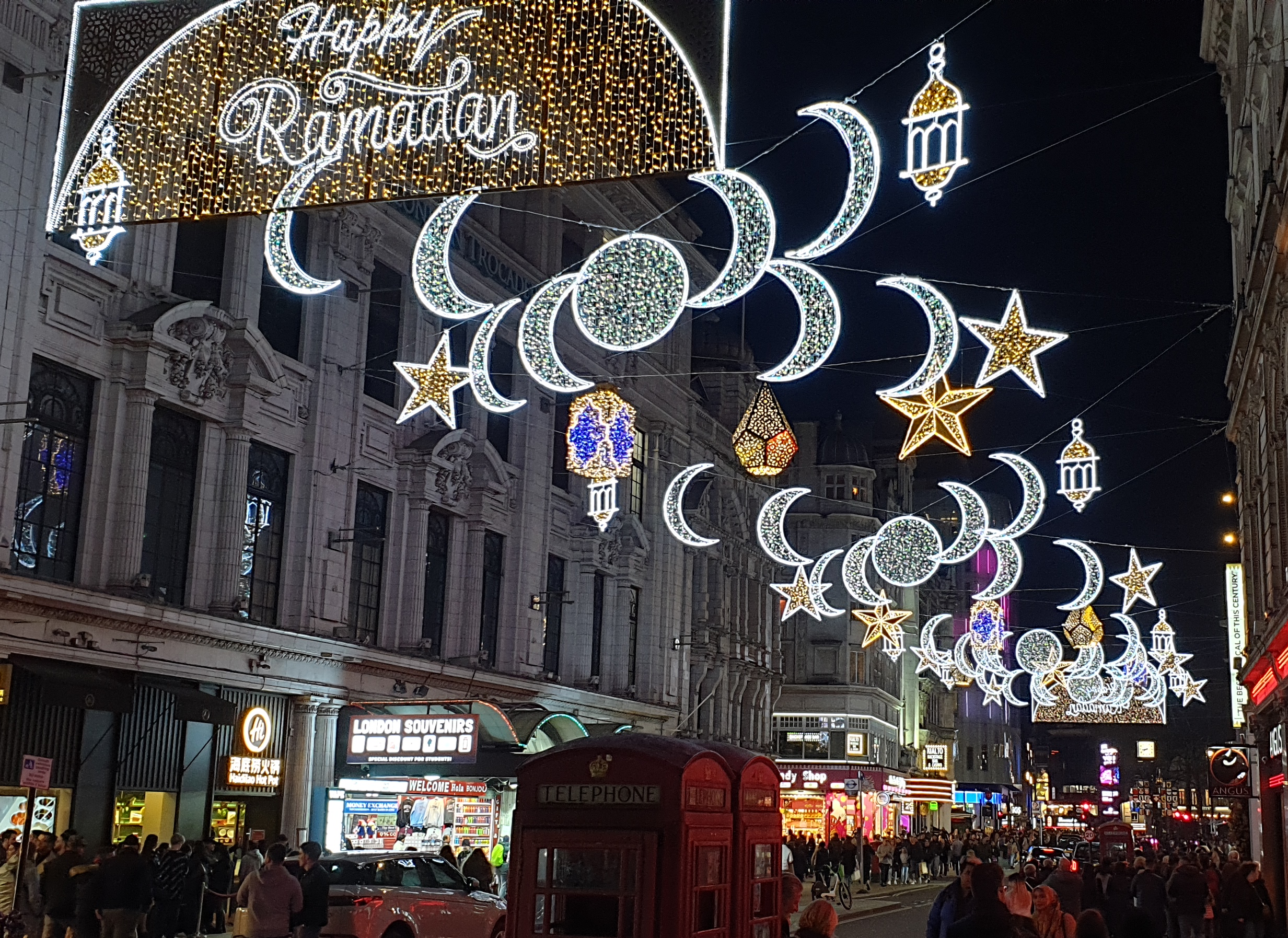
Ramadan decorations line London’s iconic Coventry Street.
The advice has fueled questions about whether families with such strict religious expectations might prefer living in a society governed by Islamic law.
But Western countries continue to attract migrants with the promise of economic opportunity, public services, and broad civil liberties. Critics argue that these same systems often bend over backward to accommodate religious demands once newcomers arrive.
In that environment, appeals to “anti-racism,” “equality,” and “non-discrimination” can quickly become tools to push institutions toward adapting their rules.
“A school in which there are students of different faiths and beliefs provides an ideal place to learn about, understand and learn from those with different religions and cultures,” the document says.
In liberal theory, that diversity should promote understanding. In practice, critics say it can resemble a constant cultural tug-of-war.
“Schools need to take account of different religious, cultural, linguistic and educational needs when meeting with families. For example, a Muslim father may not wish to shake hands with a female teacher or a Muslim mother with a male teacher, but some Muslims have no objection to doing so.”
The guidance reflects a broader tension in Britain, where officials often champion humanistic and feminist values while simultaneously carving out religious accommodations that critics say run directly against those principles.
The contradiction is especially stark, critics note, in light of Britain’s long-running grooming gangs scandal, in which groups of mostly Pakistani, Muslim men were convicted in multiple cities of systematically abusing underage British girls over decades. Even Pakistani-“British” police officers partook in the despicable acts.
Download the FREE Trending Politics App to get the latest news FIRST >>