
France, Germany create panel to advance shared nuclear deterrence plans
BERLIN — France and Germany this week created a high-level nuclear steering group, marking another step toward European nuclear deterrence, as questions hang here over the long-term reliability of the United States as a security guarantor.
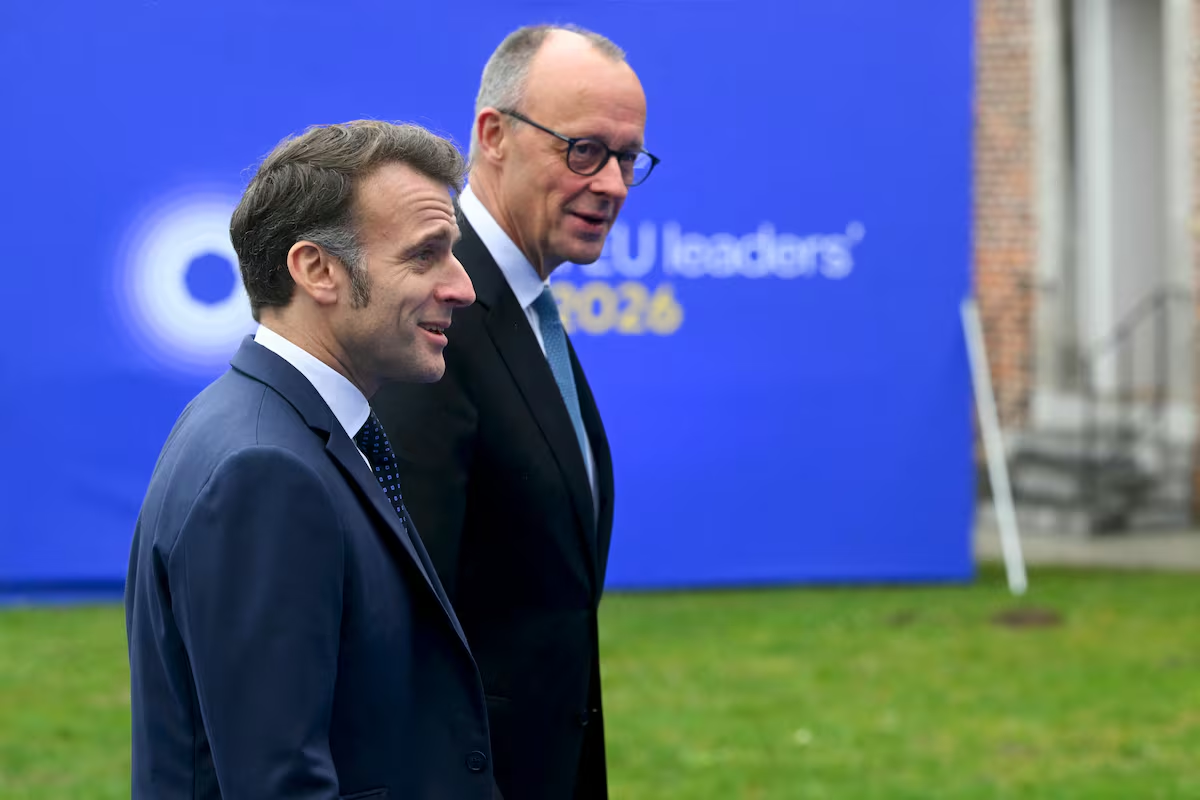
In a joint declaration, President Emmanuel Macron and Chancellor Friedrich Merz said the new body would serve as a bilateral framework for “doctrinal dialogue and the coordination of strategic cooperation,” including consultations on the appropriate mix of conventional, missile defense and French nuclear capabilities. The announcement, grounded in the bilateral 2019 Treaty of Aachen, follows months of exploratory talks that Merz had revealed publicly at the Munich Security Conference in February.
It also came alongside a major speech by Macron in which he announced significant shifts to France’s nuclear doctrine, an increase in the country’s nuclear stockpile, and the option of extending the French nuclear-deterrence umbrella across the continent, with the president specifically naming the U.K., Germany, Poland, the Netherlands, Belgium, Greece, Sweden, and Denmark.
Berlin and Paris agreed to take concrete steps beginning this year − notably, German conventional participation in French nuclear exercises and joint visits to strategic sites.
The joint statement was careful to affirm that the arrangement “will add to, not substitute for, NATO’s nuclear deterrence and NATO’s nuclear sharing arrangements,” which hinge on U.S. presence in Europe, while also noting Britain’s role in the alliance’s nuclear arsenal.
The U.K. has also taken steps to modernize its nuclear force.
The joint statement further said that both countries would continue to comply with their obligations under the Nuclear Non-Proliferation Treaty.
Russia and a number of non-nuclear states have long objected to nuclear sharing as a potential breach of the letter or spirit of the NPT. Since 2023, Russia has itself engaged in nuclear sharing by placing some of its warheads on the territory of Belarus.
The Franco-German initiative appears to carry the tacit backing of the Trump administration. At a Council on Foreign Relations event in early March, Elbridge Colby, the under secretary of defense for policy, endorsed a greater European nuclear role within NATO.
“I think it’s perfectly appropriate and, from our point of view at the Department of War, reasonable for there to be a greater European complexion to NATO nuclear deterrence,” he said.
That endorsement reflects a broader strategic shift. Colby has consistently pushed European allies to assume primary responsibility for their own conventional defense while the U.S. refocuses on deterring China − a posture he outlined at a NATO defense ministers’ meeting in Brussels in February, where he pledged Washington would continue providing extended nuclear deterrence but that conventional capabilities would be “more limited and focused.”
The Franco-German steering group will also address capabilities below the nuclear threshold, including early warning, air defense, and deep precision strike, which are areas where European shortfalls have long been identified as a problem in any potential high-intensity conflict with Russia.
Linus Höller is Defense News’ Europe correspondent and OSINT investigator. He reports on the arms deals, sanctions, and geopolitics shaping Europe and the world. He holds master’s degrees in WMD nonproliferation, terrorism studies, and international relations, and works in four languages: English, German, Russian, and Spanish.