
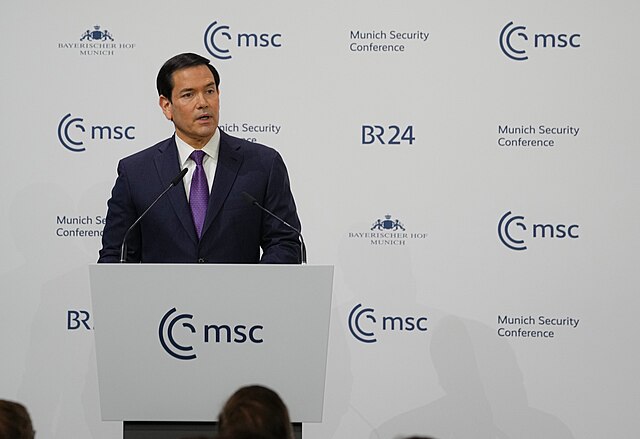
Marco Rubio In Munich – JP
Please Follow us on Gab, Minds, Telegram, Rumble, Truth Social, Gettr, Twitter, Youtube
Guest post by Simon Levy, Edited by Eduardo Vidal
Mexico City –
Alignment or Confrontation – – Marco Rubio: The Philosophical Champion of 21st-Century Western Civilization in the Trump Era.
There are speeches that make headlines; and there are speeches that shape destiny. United States Secretary of State Marco Rubio opened his address this month at the Munich Security Conference with a masterful maneuver: He simultaneously dismantles both: (1) the dogma of globalist neoliberalism; and (2) the deceiving pretense of the false lefts that, for decades, have lived off selling indignation while administering ruin.
In just a few lines, he exposes that: (1) free trade without reciprocity was not modernity but industrial suicide; (2) the surrender of sovereignty to international bodies was not cooperation but capitulation; and (3) climate dogma, mass migration and production offshoring were not humanitarian policies, but deliberate instruments of weakening the working classes of the West.
With that clarity, Rubio does not merely criticize an economic model: he closes out an entire ideological era, because he also strips the hypocritical left of its narrative — those who speak of social justice while handing over job security and national identity to transnational interests.
What he constructs, then, is not a traditional conservative posture, but a new doctrine: an ideology of social sovereignty grounded in common sense, where the nation once again becomes the citizen’s shield, industry returns as the heart of collective dignity, and the state recovers its original purpose — to protect its people before pleasing the world.
Most political speeches are born to last a media cycle: a morning on television, an afternoon on social media, and a week in commentary from analysts who confuse circumstance with history. But from time to time, a different speech appears — one that does not seek to persuade the audience of the day, but to speak to posterity. One that does not aim to win an election, but to reorder how a civilization sees itself.
That is what happened with the speech delivered by Secretary Rubio in Munich.
In his speech, we are not facing just another rhetorical piece; we are not facing a diplomatic intervention. We are not facing a protocol message delivered in Europe to fulfill transatlantic liturgy; we are facing a declaration of civilization.
Secretary Rubio did not speak as merely a chancellor or foreign minister. He spoke as an heir. He spoke as a man who understands that foreign policy is not a catalogue of agreements, but an invisible battle for the moral architecture of the world. In a single speech, he outlined with surgical precision a map of what lies ahead: (1) either a new Western century; or (2) the definitive collapse of the project born in Greece, refined in Rome, spiritualized in Jerusalem, institutionalized in Europe, and later carried across the Atlantic to become America.
His speech was not a speech; it was a coordinate. And when a man pronounces coordinates, he is not describing the world — he is giving it instructions.
The Moment the West Stopped Pretending
What is most powerful about Secretary Rubio is not what he said, but what he dared to admit. For the West’s great sin over the last few decades was not naivete — it was arrogance disguised as morality.
After the fall of the Berlin Wall, Europe and America did not merely celebrate a geopolitical victory; they celebrated a psychological victory. That euphoria led them to believe that history had ended, that ideological conflict had died, that commerce could replace identity, that supply chains could replace sovereignty, and that prosperity could be sustained indefinitely without strength, sacrifice, borders or nationhood.
The West became an empire of comfort. And like every empire accustomed to comfort, it began to hate its own strength, to feel ashamed of its own past, and to attempt to correct its history as if it were an error.
Secretary Rubio states it with elegant bluntness: (1) Deindustrialization was not inevitable; it was a decision; (2) Energy dependence was not inevitable; it was a decision; (3) Outsourcing sovereignty to international institutions was not inevitable; it was a decision; and. (4) Opening borders until dissolving the very concept of nationhood was not inevitable; it was a decision. For the first time, an American leader in a European forum did not speak as administrator of the world order, but as prosecutor of Western self-destruction.
Secretary Rubio does not soften his message. He does not ask permission. He does not use the tepid language of a diplomat seeking approval. Instead, he speaks as someone who understands that history does not reward the cautious — it rewards the decisive. At its core, his message is clear: the West was not defeated. It slowly surrendered to itself.
Trump as Rupture, Rubio as Continuity
Secretary Rubio’s speech can only be understood within one reality: President Trump broke the old consensus, but Secretary Rubio is building the new doctrine: (1) Trump was the hammer; Rubio is the architect; (2) Trump was the cry that awakened a country; Rubio is the text that organizes it; and (3) Trump struck down the old globalist dogma. Rubio is formalizing the new paradigm intellectually. History is not sustained by shouts; it is sustained by ideas converted into institutions.
Secretary Rubio is not speaking about public policy alone; he is speaking about civilizational identity. When he asserts that Europe and America are united not only economically and militarily, but also spiritually and culturally, he returns foreign policy to its origin — not in its immediate interest, but in the consciousness of belonging to something larger than the present.
In defining the West as a civilization grounded in the Christian faith, he is not invoking religion as dogma, but as cultural root — an explanation for the concepts of personhood, individual liberty, moral responsibility, objective truth, and law above power.
In geopolitical terms, this is dynamite. For the West’s great enemy today is not merely an army — it is the loss of meaning. And Secretary Rubio understands this.
China and Russia: The Return of Real Conflict
For decades, the West wanted to believe that China was a commercial partner and Russia a rational actor. It believed economic integration would domesticate them. It was a historic error and delusion. China did not integrate to become Western; it integrated to buy time and technology, and to gain dependent countries and territories. Russia did not re-enter the global system to become democratic; it did so to rebuild an imperial project grounded in resentment and force.
Secretary Rubio’s message is clear: the era of Western naivete and delusion is over. What is being announced is a reconfiguration of Western power toward strategic self-sufficiency — reindustrialization, real military defense, border control, energy independence and technological sovereignty.
When he speaks of Western supply chains for critical minerals, he is speaking of the heart of the 21st century. Whoever controls lithium, rare earth elements, semiconductors, and industrial automation will shape the planet’s destiny.
Secretary Rubio is announcing a new era of civilizational competition — where economics is weaponized, technology is dominance, migration is strategic, and energy is coercive leverage.
From Kissinger’s Realism to Civilizational Ideology
Henry Kissinger embodied pragmatic realism — balance of power, strategic coldness, stability over morality. Secretary Rubio is not Kissinger. He is restoring morality — not sentimental morality, but civilizational structure — as the axis of strategy.
Kissinger sought equilibrium among powers. Rubio seeks internal Western cohesion. Kissinger managed a multipolar world. Rubio envisions identity blocs in dispute.
This distinction is decisive. Today’s adversaries do not merely seek territory. They seek to fracture societies, infiltrate narratives, and erode identity from within. Rubio understands this. That is why he speaks of borders, sovereignty, cultural pride, history, faith, deindustrialization as political betrayal, and mass migration as existential crisis.
Secretary Rubio is not defending a system. He is defending a civilization.
The Western Hemisphere: An Unwritten Doctrine
An unspoken line runs through the speech: the Western Hemisphere will no longer be anyone’s periphery. The repositioning of America implies reclaiming political, economic and strategic control of the American hemisphere.
This has direct implications for Mexico and the rest of Latin America. For decades, the region was secondary — useful rhetorically, irrelevant strategically. Criminal regimes were tolerated. Dictatorships normalized. Narco-states accepted as background noise. Chinese infrastructure penetration overlooked. Russian influence exploited regional resentment. That era is over.
Secretary Rubio suggests a new hemispheric doctrine in which American sovereignty is defended not only in Texas or Florida, but also in Caracas, Havana, Managua, and financial corridors laundering narcotics money. When America defines a region as a central theater of national security, neutrality disappears. Only alignment or confrontation remain.
Mexico: The Border Is No Longer Geographic, But Political
If mass migration is framed as a civilizational crisis, Mexico ceases to be merely a neighbor and becomes a strategic frontier of stability or instability. Mexico will be measured not by diplomatic rhetoric, but by its capacity to combat organized crime, contain migration flows, prevent Chinese penetration of critical infrastructure, control ports, monitor financial systems, and prevent its territory from serving as a logistics platform for transnational criminal networks.
Secretary Rubio’s implicit message is stark: a country that cannot control its territory cannot be treated as a reliable ally.
Latin America: The End of Ideological Romanticism
For the rest of Latin America, this speech signals the end of an era: (1) the era in which the 21st-century socialism of Chavez, Lula, Correa and others like them could present itself as social justice, while constructing totalitarian regimes; (2) the era in which Venezuela could be portrayed as an alternative model, while devolving into a narco-state; and (3) the era in which Cuba could maintain romantic symbolism, while exporting subversion and political control.
Secretary Rubio speaks not as diplomat, but as prosecutor of history. The new American language will not be “corruption,” it will be “threat.” And when a political structure is defined as a threat, the instruments for dealing with it shift: sanctions, blacklists, financial prosecution, asset freezes, visa restrictions, intelligence cooperation.
The New Torch Has Been Lit
President Trump initiated the rupture; Secretary Rubio is systematizing it.
Secretary Rubio is constructing the narrative of a “New West,” framing President Trump’s impulse within moral and historical architecture. He is not speaking merely of elections, but of saving civilization. When America believes that it is saving a civilization, foreign policy ceases to be diplomacy, and becomes strategic crusade.
This speech will translate into accelerated reindustrialization, exclusion of China from critical supply chains, unapologetic energy policy, migration as national security doctrine, expanded hemispheric intelligence operations, and intensified pressure against governments tolerating narco-structures.
The new framing will not be “democracy versus authoritarianism,” but “civilization versus collapse.” The world has crossed an invisible boundary—between a West ashamed of itself, and a West reclaiming legitimacy.
Secretary Rubio’s speech is the kind understood years later, when events render it prophetic. He has lit a torch. And when a torch is lit in darkness, it is not to admire the landscape. It is to advance.
Editor’s Notes:
1. See also Samuel Huntington, The Clash of Civilizations and the Remaking of World Order (1996).
2. Marco Rubio’s speech in Munich will be included in Readings in the Historical Sources of Western Civilization, to be published hereafter.

Simon Levy is a lawyer and economist based in Mexico City. He is an observer of international business transactions and their cultural underpinnings.