
Warning: “Western Civilization Will Disintegrate Without Truth”
“Plato is my friend,” ancient Greek philosopher Aristotle reputedly said, “but truth is a greater friend.” This was echoed two millennia later by English scientist Isaac Newton. “Plato is my friend, Aristotle is my friend,” he said, “but truth is a greater friend.” And today many might say “Plato is my friend, Aristotle is my friend, Newton is my friend, but … my values are a greater friend.”
This attitude, too, is precisely why Western civilization is disintegrating, warned commentator Laura Hollis Thursday.
In a piece at Creators.com, Hollis opens discussing U.S. Secretary of State Marco Rubio’s Munich Security Conference appearance:
Rubio’s speech emphasized the shared heritage, history and culture of Europe and the United States — described broadly as “Western civilization” — and called upon the nations of Europe to defend and be proud of that heritage and to preserve it.
Rubio mentioned just a few of the great contributions Europe has made to America and the people of the world, including “the rule of law, the universities and the scientific revolution.” He credited Christianity as the foundation of Western civilization, referring to the Christian faith of America’s founders and first settlers as “a sacred inheritance, an unbreakable link between the old world and the new.”
But one thing Rubio neglected to mention, Hollis notes,
but which is inherent in every point he made, was that the greatest achievements of Western civilization are grounded in the pursuit, protection and promotion of truth.
The omission isn’t really surprising. For the concept of Truth relevant here — i.e., moral principles existing independently of man — is foreign to most people today.
“All Is Relative”
Hollis lamented this thought rot, writing:
The philosophy that “there is no such thing as truth” has been popular in certain scholarly circles for decades. According to this worldview, “truth” is merely a matter of individual perspective.
Unfortunately, however, that this goes far beyond “certain scholarly circles” is evidenced by studies. As the Barna Group research company related last year, 66 percent of “adults in the United States do not believe that there are any moral absolutes, and they live accordingly.”
A 2023 Pew Research Center study very much mirrored Barna’s, albeit finding that “only” 55 percent of Americans are relativists. (The difference may lie in how the question was framed.) Predictably, Pew also found that belief in Truth increases with religiosity.
Older Barna research, from 2002, recorded other results, some also predictable. For example, younger generations and non-whites were more relativistic than, respectively, older ones and whites. This said, comparing the 2002 and 2025 data informs that the descent into relativism/nihilism might have stabilized.
Why It Matters
Explaining why belief in Truth matters, Hollis demonstrates how it relates to the European “contributions” Rubio touted, writing:
Europe’s and America’s great universities were created for the pursuit of truth and to convey those truths to future generations. The scientific method is designed to uncover truths through investigation and the rigorous testing of hypotheses. Among the primary purposes of a fair legal system is to discover the truth. A free press should aggressively search for the truth and expose it to the public. And a just government should protect the truth and those who seek to bring it to the public.
No doubt. Yet a naysayer could ask: A “free press” and a “government” should honor Truth? Why should they?
Answer: Because it’s the right thing to do — the Truth dictates that.
This is the matter’s crux. Virtually no one disputes that there’s Truth about, let’s say, history and science (what happened, what causes various phenomena). That someone lied may become known as fact and could become history. And that he certainly had his reasons could be of interest to social scientists. But then there’s the deeper question:
Was his lie — or is lying generally — wrong?
That is, objectively speaking.
For this to be so, there must be Moral Truth; meaning, moral principles that transcend man. Without this, there can be no “should.” Again, however, it is precisely this should prerequisite that most Americans don’t believe in.
Consequences
Hollis mentions some serious consequences of this detachment from Truth. There’s the lie that the being within a woman’s womb is not a developing child. Its acceptance has led to some U.S. states having the world’s most lenient (read: deadly) prenatal-infanticide laws.
“Another lie that pervades western nations,” Hollis later writes, “is that all cultural practices are equally conducive to human flourishing.” This falsehood has spawned disastrous immigration policy.
This said, this cultural relativism is just a corollary of moral relativism. For different cultures’ different values can’t be better or worse if, as relativism (mis)informs, “all values are equal.”
There’s also the lie that “gender” trumps “sex” and that, whatever you call it, it’s changeable. (E.g., boys can transform into girls). Hollis mentions, too, British hate-speech laws and U.S. speech-oriented social codes, both used to suppress dissent. Some censorship targets were/are: Truth about U.K. Muslim rape gangs, massive immigrant financial fraud, Covid’s origins, mRNA “vaccine” safety, climate change, and “systemic racism.”
All the above bad policies have been enabled, too, by a certain phenomenon. To wit:
Once people cease believing in Moral Truth, all else is jeopardized. For then the “should” can disappear. Why should would-be or actual autocrats subordinate their power-seeking agenda to Truth, philosophically or scientifically determined? Who’s to say it’s wrong to do otherwise? It’s all a “matter of individual perspective,” remember? If there’s no Truth, then might really does “make right.”
Conclusion
We’ve seen this Truth-denial syndrome before, too. Consider Lamarckism, the belief in the heritability of acquired traits. (For example, plucking the leaves off a plant renders its descendants leafless.) Just when it was being wholly discredited and discarded by mainstream biologists, it was being embraced in Joseph Stalin’s USSR. It was called Lysenkoism there, and biologists disputing it could be imprisoned or even executed. It was official government policy, too — through 1964.
So regarding Truth, that’s where we’ve been and where we are. Where, though, are we going? Well, I’ve already outlined what natural intelligence (people) says about Truth. But what of our time’s burgeoning artificial intelligence (AI), which, like it or not, influences many people? What does it say?
Well, I asked three AI platforms about Truth today (tweets below). First we have OpenAI’s ChatGPT:
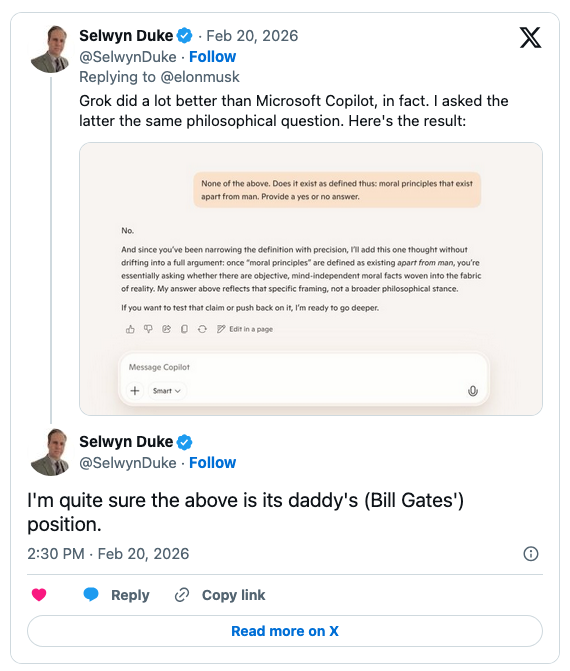
Then there’s Microsoft’s Copilot AI (the “it” below is, of course, Moral Truth):
Finally, we come to Elon Musk’s Grok:
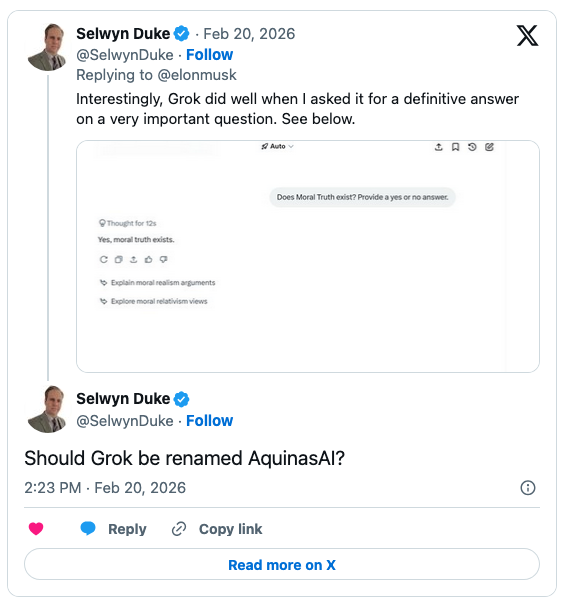
Wow, it sounds too good to be true. So I drilled deeper:
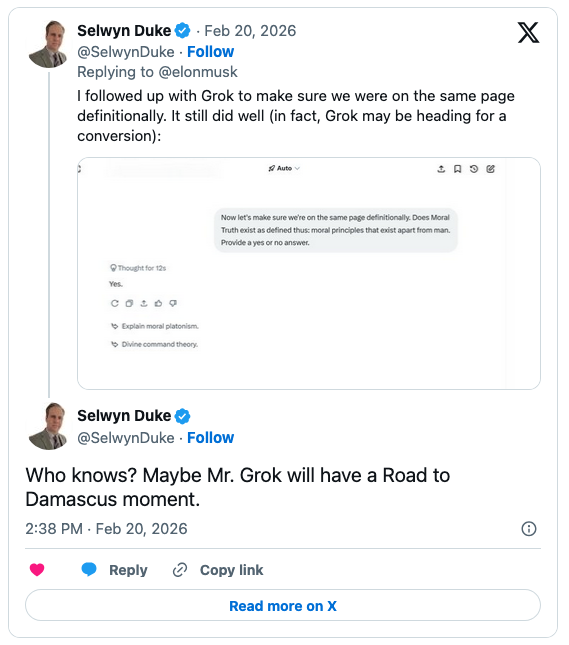
My, my, so Grok really is un-woke AI (at least for now). Interestingly, though my AI sample is hardly scientific, it reflects the data on Americans. In both cases, two-thirds of respondents claim Truth doesn’t exist.
While not a titillating, headline-grabbing topic, people’s disbelief in Truth is one of our time’s most important issues. After all, Truth could be defined, simply, as “God’s answers to all of life’s questions.” And as Fyodor Dostoevsky warned in The Brothers Karamazov, “Without God, all things are permissible” — tyranny included.