
Abortions Drop 7% in Pennsylvania as Extra Infants are Saved
Pennsylvania’s 2024 abortion report was published online by the Pennsylvania Department of Health (DOH) in December 2025. The report shows that abortions decreased from the previous year. The data published by the state does not include the total number of abortions obtained by Pennsylvania residents out of state or the number of self-managed abortions on women outside of the healthcare system.
The state’s report also does not contain the number of mail-order abortion drugs obtained by Pennsylvania residents prescribed by licensed abortion providers in Pennsylvania or in other states. In a separate section, Charlotte Lozier Institute (CLI) will describe data provided by the Guttmacher Institute’s Monthly Abortion Provision Study that details the total number of abortions occurring in the state in 2024 as estimated by Guttmacher’s sample survey and mathematical models. CLI will also describe Guttmacher’s estimated number of abortions obtained by Pennsylvania women in other states. Guttmacher’s abortion estimates include the number of abortions obtained at brick-and-mortar facilities and those provided via telehealth and virtual providers in the United States.
Pennsylvania’s statute code defines abortion as “the use of any means to terminate the clinically diagnosable pregnancy of a woman with knowledge that the termination by those means will, with reasonable likelihood, cause the death of the unborn child…” (18 Pa. C.S. § 3203). In Pennsylvania, abortion is legal through 23 weeks of gestation (or 21 weeks post-fertilization). Exceptions for abortions 24 weeks and later include risk of death to the mother or “substantial and irreversible impairment of a major bodily function” (18 Pa. C.S. § 3211).
SUPPORT LIFENEWS! If you want to help fight abortion, please donate to LifeNews.com!
Statistics and Changes in Pennsylvania Abortions, 2022-2023

The report does not include information on Planned Parenthood’s Pennsylvania abortion market share.
Abortion Totals and Trends
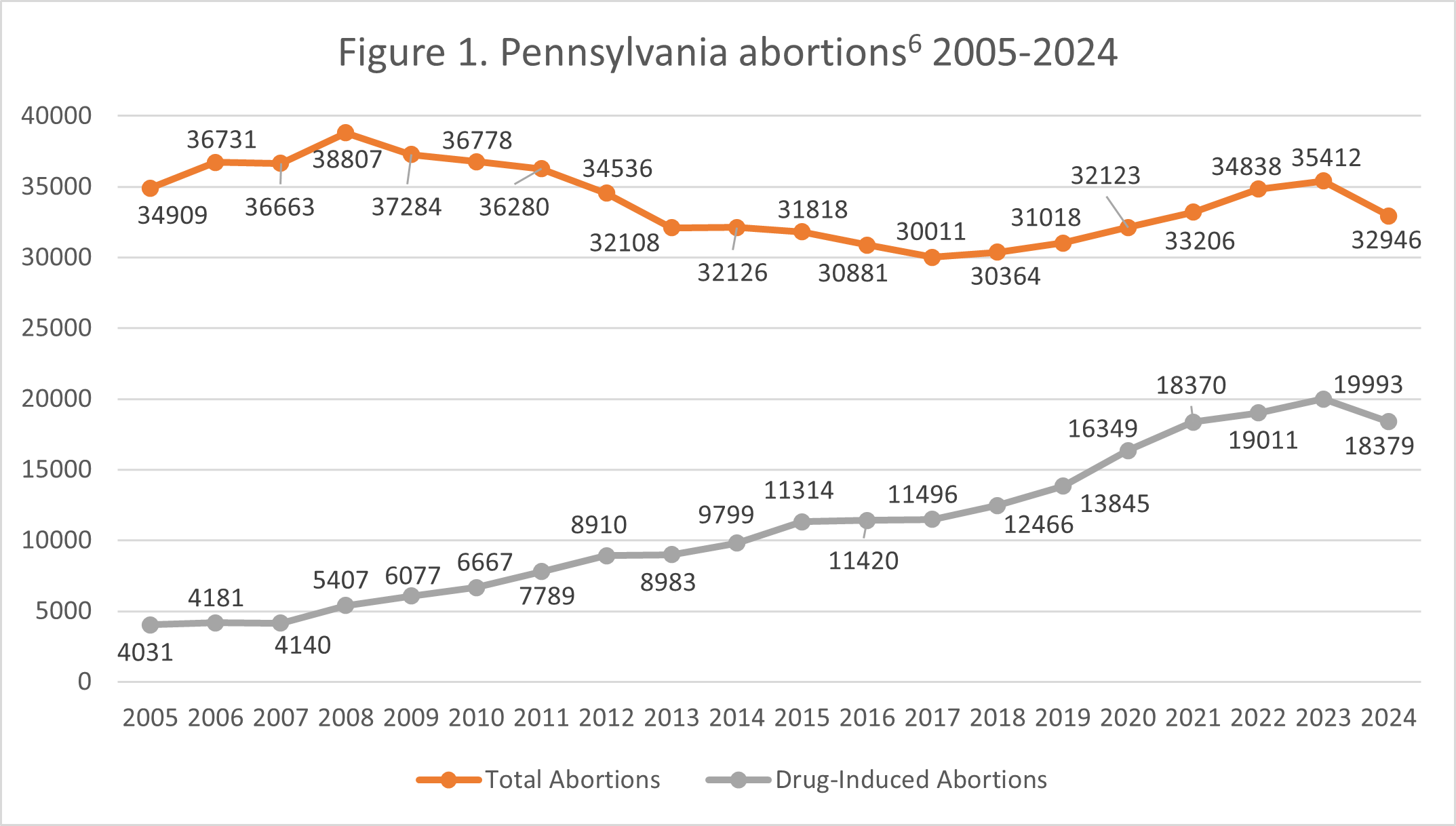
There were 32,946 abortions reported in Pennsylvania in 2024, a decrease of 7% from 2023. Drug-induced abortions decreased by 8% and made up 56% of the state total (Fig. 1). CLI estimates that Pennsylvania’s abortion rate decreased by 7% to 13.3 abortions per 1,000 women ages 15 to 44 from 14.4 in 2023 (Fig. 2).1 As of January 2026, 24 states have released 2024 abortion statistics, with 10 states showing a decrease from 2023.
State Report Summary
In 2024, 93% of Pennsylvania abortions were performed on resident women, while 7% were performed on women from other states. The latter included 2% each on women from Delaware and Ohio, and 1% each on women from West Virginia, New Jersey, and other states. Fourteen abortions were performed in Pennsylvania on Maryland women and 14 on New York women.
Eight percent of Pennsylvania abortions were performed on young women under the age of 20, with 2% on girls under the age of 18. Twenty-six percent of the abortions were obtained by women ages 20 to 24, and 28% by women ages 25 to 29. Thirty-five percent of the abortions were performed on women in their thirties. Four percent of Pennsylvania abortions were obtained by women aged 40 and above.
Forty-two percent of Pennsylvania abortions were obtained by white women, and 45% by Black or African American women. CLI estimates that Pennsylvania’s Black or African American abortion rate, 42.9 abortions per 1,000 women ages 15-44, was almost six times the white abortion rate of 7.4 abortions per 1,000 women. Abortions on Asian or Pacific Islander women accounted for 4% of the total, while another 5% of the abortions were performed on women of multiple races. One percent of the abortions were performed on women of other races, and 3% were on women of unknown race. Eighty-six percent of the abortions were performed on non-Hispanic women and 14% on Hispanic women.
Eighty-eight percent of Pennsylvania abortions were obtained by unmarried women, compared to 11% by married women. Less than 1% were performed on women of unknown marital status. Thirty-eight percent of the abortions were performed on women with no previous live births, and 51% were performed on women with no prior abortions. Twenty-five percent of Pennsylvania abortions were obtained by women with one prior live birth, and 36% were performed on women with two or more live births. Twenty-four percent of the abortions were performed on women with one prior abortion, and 25% were performed on women with more than one prior abortion.
Fifty-six percent of the abortions reported in 2024 were drug-induced. Thirty-nine percent of the abortions were performed via suction curettage, and 5% were dilation and evacuation procedures. There were 10 abortions performed using sharp curettage. Additionally, there were four abortions performed via intra-uterine instillation and one via hysterectomy/hysterotomy. One other abortion was performed using some other means.
Sixty-nine percent of the abortions occurred at eight weeks of gestation or earlier. Fourteen percent were reported between nine and 10 weeks of gestation, and 6% were performed between 11 and 12 weeks. Four percent of abortions occurred between 13 and 14 weeks, another 4% between 15 and 17 weeks, and 2% occurred between 18 and 20 weeks of gestation. There were 546 abortions (1.7% of the total) performed between 21 and 23 weeks of gestation; no abortions were reported at 24 weeks or later. Pennsylvania limits abortion at 24 weeks of gestation. Compared to 2024, there was a 3% increase in the number of abortions performed at eight weeks of gestation or earlier, following a 7% increase in abortions performed at this stage between 2022 and 2023. One plausible explanation for the continued increase in the number of abortions performed at eight weeks of gestation or earlier could be the increased accessibility of drug-induced abortions, which are often performed at early gestational ages.
Abortion Complications
There were 12 abortion complications reported at the time of the procedure, up from nine in 2023, and 174 pregnancies complicated by pre-existing medical conditions. The report does not indicate what these preexisting conditions were, but Pennsylvania law lists as possible examples hydatid mole, endocervical polyp, malignancies, radiation exposure, genetic indications, psychological indications, rape, incest, and rubella disease.
Separately, there were 480 abortion complications reported subsequent to the abortion procedure, a decrease of 8% from 2023. Sixty-six percent of these resulted from drug-induced abortions, while 15% were caused by suction curettage procedures and 13% by dilation and evacuation abortions. This is consistent with peer-reviewed research demonstrating higher complication rates for drug-induced versus surgical abortion. Three percent of the complications resulted from sharp curettage procedures despite only 10 being performed in 2023; it is possible some complications were caused by abortions performed the previous year or in other states. Three percent of the complications were caused by other or unknown abortion methods. Seventy-eight percent of the complications were retained products of conception, 16% were bleeding, and 2% were infections. Three percent were some other type of complication.2
Abortions Performed by County of Occurrence and Residence
Abortions were performed in 14 of Pennsylvania’s 67 counties. The following is a breakdown of the number of abortions occurring in Pennsylvania by county in 2023 versus 2024.
| # of Abortions (2024) | # of Abortions (2023) | |
| Allegheny County | 7,517 | 7,894 |
| Berks County | 698 | 945 |
| Bucks County | 1,014 | 1,640 |
| Chester County | 791 | 733 |
| Dauphin County | 1,165 | 1,474 |
| Delaware County | 1,483 | 1,828 |
| Lancaster County | 523 | 512 |
| Lehigh County | 1,799 | 2,057 |
| Luzerne County | 808 | 883 |
| Montgomery County | 996 | 1,014 |
| Montour County | 12 | 8 |
| Northampton County | 2,371 | 2,306 |
| Philadelphia County | 12,466 | 12,526 |
| York County | 1,303 | 1,592 |
| Total | 32,946 | 35,412 |
Abortions by county of residence (the top 5):
- Philadelphia – 10,385 abortions
- Allegheny – 3,608 abortions
- Delaware – 2,185 abortions
- Montgomery – 1,880 abortions
- Berks – 972 abortions
Breakdown of Abortion Providers in Pennsylvania3
| # of brick-and-mortar locations | 20 |
| # of independent centers | 4 |
| # of Planned Parenthood centers | 12 |
| # of hospitals/doctors’ offices that perform abortions | 4 |
| # of abortion drug providers | 20 |
| # of abortion drug-only providers | 7 |
| # of surgical and abortion drug providers | 13 |
| # of online mail-order abortion drug companies licensed in the state | 10 |
| # of brick-and-mortar locations that also mail abortion drugs | 1 |
| Latest gestational age that a center performs surgical abortion | Through 23 weeks |
CLI reviewed Pennsylvania DOH’s most recent patient safety and building safety (when available) reviews for the four independent abortion centers in the state and 12 Planned Parenthood abortion-performing locations in the state. Reviews of hospitals and/or doctors’ offices that perform abortions are not included in the abortion facility database. These reports detail unannounced investigations by the Department investigating whether facilities comply with patient and building safety requirements legislatively mandated by the state. The reports for the 16 facilities were conducted at different points throughout 2025, depending on the facility. Some facilities were evaluated for both patient safety and building safety (eight facilities), while the other eight were evaluated solely for patient safety. Why a facility was investigated for both patient safety and building safety or solely building safety was not explained. Of the 16 facilities investigated, the Planned Parenthood Southeastern Pennsylvania Far Northeast Health Center was found to be in violation of the Pennsylvania DOH’s Rules and Regulations for Ambulatory Care Facilities, Annex A, Title 28, Part IV, Subparts A and F, Chapters 551-573, November 1999. Specifically, patient safety was endangered by the facility’s failure to:
- Appropriately store controlled substances.
- Maintain a sanitary environment. There was noted damage to the walls and flooring, dirty baseboards, dusty operating rooms and equipment, and a reddish/brown stain on the carpet in the patient waiting room.
- Maintain a facility cleaning log.
The report notes that plans for correction for each complaint were established with facility personnel.
Guttmacher Data
In 2024, Guttmacher estimated that 38,560 abortions occurred in Pennsylvania, while the state reported 32,946. Guttmacher also estimated that of the 38,560 abortions performed in Pennsylvania, 2,590 were obtained by women who traveled from other states to Pennsylvania to get an abortion. To see the number of abortions obtained in Pennsylvania by women from various states, see the following table:4
| States of Residence for Women Who Traveled to Pennsylvania | # of Abortions Obtained by Non-Resident Women in Pennsylvania, 2024 |
| Ohio | 1,350 |
| West Virginia | 790 |
| Delaware | 230 |
| New Jersey | 220 |
| Total | 2,590 |
Lastly, Guttmacher estimated the number of abortions that were obtained by Pennsylvania residents who traveled to other states to obtain an abortion. To see the number of abortions obtained by Pennsylvania residents in various states, see the following table:4
| States Traveled to by Pennsylvania Women | # of Abortions Obtained by Pennsylvania Women Who Traveled to Other States to Get Abortions, 2024 |
| New Jersey | 1,640 |
| New York | 810 |
| Maryland | 790 |
| Delaware | 120 |
| Total | 3,360 |
According to Guttmacher’s estimates, the number of non-resident women who obtained abortions in Pennsylvania increased by 20% from 2023 to 2024 while the number of Pennsylvania women who traveled to other states to receive abortions decreased by 36%. The reason for these dramatic changes is not entirely clear. One possible explanation could be the increased accessibility of abortion drugs in Pennsylvania.
When looking at the totals estimated by Guttmacher and those reported by the state, one can see a large discrepancy between the totals. To see those discrepancies further highlighted, see below.

One possible explanation for these differences is that Guttmacher’s estimates include both abortions occurring at brick-and-mortar facilities and telehealth abortions, where abortion drugs are mailed to the woman, while the state does not account for telehealth abortions in its total. CLI emailed the Pennsylvania DOH inquiring whether the state collects and includes telehealth data in their reported totals. The DOH answered that they do not. Data from the Society of Family Planning (SFP) provides additional context. Their #WeCount project estimated that of the 39,270 abortions occurring in the state, 31,090 were performed in person at brick-and-mortar facilities, and 6,350 were performed via mail-order abortion drugs.5 The differences between Guttmacher’s and SFP’s estimated abortion totals and the state’s reported total (a difference, respectively, of 5,614 abortions and 6,324 abortions) can at least be partially explained by the state’s exclusion of the telehealth abortions from their reported total. Because a majority of mail-order abortions are obtained by residents, the difference (5,065) in the state’s reported resident total versus Guttmacher’s estimated resident total can also partially be explained by the state’s exclusion of telehealth numbers in their overall total.
State Ranking
In 2024, CLI published a paper reevaluating abortion reporting across the country, with Pennsylvania ranked in 14th place. To improve its reporting, Pennsylvania could report data from the quarterly abortion reports filed by facilities that received public funding per Pennsylvania law. The state could also report the reasons why women obtain abortions as other states do.
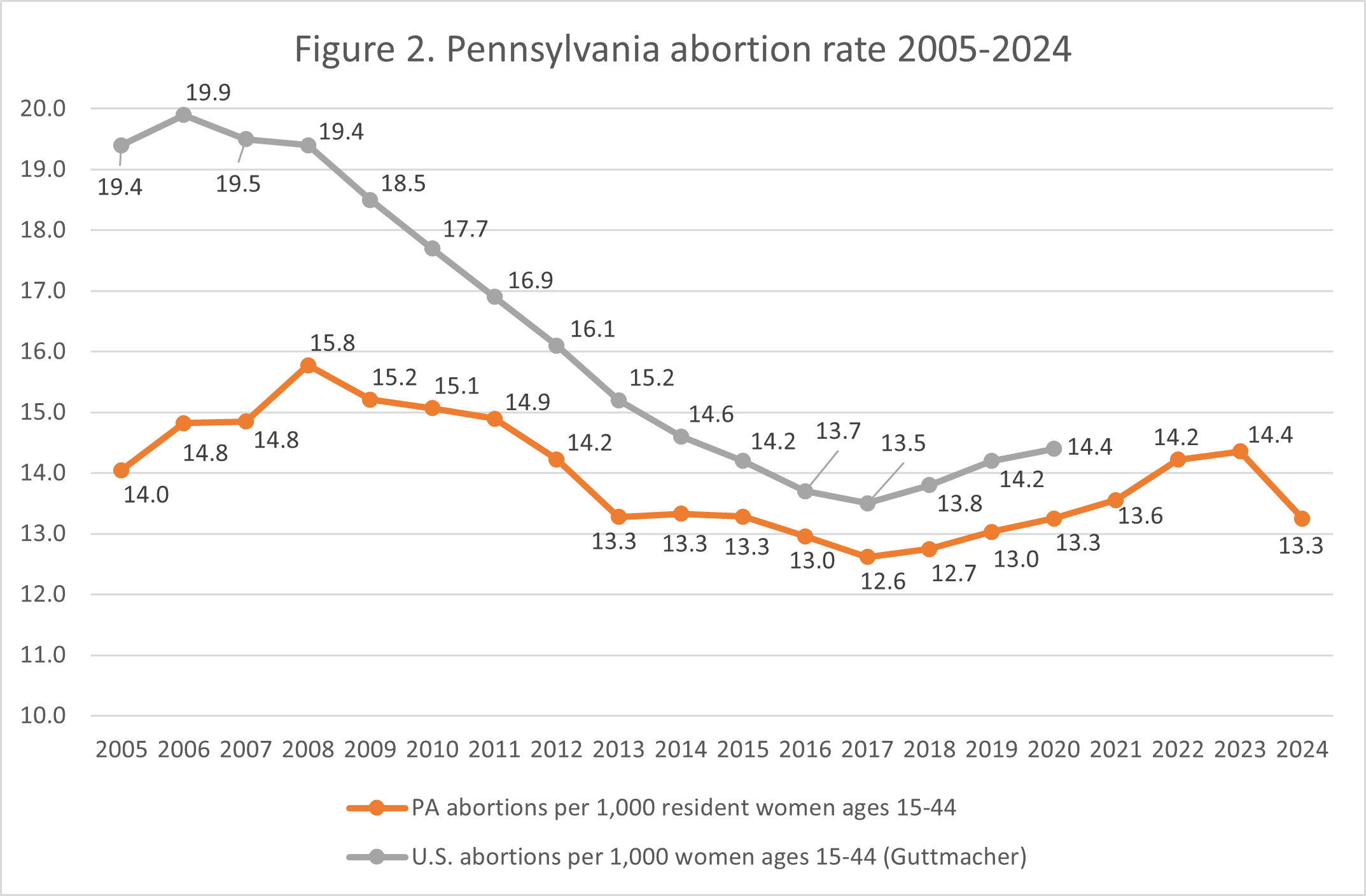
- National rates were calculated by Guttmacher Institute. Pennsylvania rates were calculated by CLI using the following formula: (total number of abortions performed in Pennsylvania ÷ number of resident women ages 15-44 [based on most recent population estimates]) x 1,000. Rates may differ slightly from previous CLI articles due to revised population estimates. Population estimates were obtained using the CDC WONDER database. Estimates for 2005-2009 are intercensal estimates of the July 1 resident population. Estimates for 2010-2019 are Vintage 2020 postcensal estimates of the July 1 resident population. Estimates for 2020-2024 are Vintage 2024 postcensal estimates of the July 1 resident population. Estimates were produced by the U.S. Census Bureau and the National Center for Health Statistics.
- Statistics on abortion complications reported here represent a minimal number of deaths and complications, as this data is collected in a non-systematic and non-verifiable way. As such, this data cannot be used to calculate either an accurate abortion mortality rate or an accurate abortion complication rate for the state.
- Provider totals do not include hospitals or physician offices not listed in databases that compile abortion provider locations in different states but do include Planned Parenthood locations, independent abortion centers, and hospitals/doctor’s offices included in databases like Abortion Finder and Ineedana. This information is up to date as of January 7, 2026.
- The Guttmacher Institute notes that their monthly abortion totals by state are estimates and that each state’s estimate is within a range of uncertainty. Furthermore, only counts of over 100 are included in Guttmacher’s estimates related to women who travel to other states to get abortions. This is partially why the residence data reported by the state is often slightly different than the totals reported by Guttmacher. Lastly, Guttmacher notes that their estimates do not reflect abortions obtained by women in pro-life states under shield laws in effect in pro-abortion states. Guttmacher’s travel and residence data can be found in the CSV folder here (State_Abortion_Travel_2024.csv). This information is updated as of January 7, 2026.
- #WeCount’s data can be found here by downloading the “Report data tables [.xlsx]” document. The #WeCount report specifies that the numbers included in their tables for abortions performed under shield laws only represent the number of women whom abortion drugs were sent to, not the number of drug-induced abortions that resulted from the mailed drugs. However, because #WeCount’s data is the only source of data that delineates the number of abortions by mode of provision (in-person, telehealth/mail order, and/or abortion drugs obtained under shield laws), their data is the best available. This information is updated as of January 7, 2026.
- The annual totals of drug-induced abortions performed in Pennsylvania in 2005, 2006, and 2007 were taken from abortion surveillance reports published by the Centers for Disease Control and Prevention because they were not reported by the state for these years.
LifeNews Note: The authors are researchers for the Charlotte Lozier Institute, where this article originally appeared.