
Thecla, the beast fighter: The saint who confronted down lions and killer seals is one in all many ‘leading ladies’ in early Christian texts
The Bible is filled with brave and courageous women.
Deborah, the judge who fought a war to protect her people. The widow Ruth, who wittingly convinces a man to marry her in order to continue the lineage of her mother-in-law, Naomi. Esther, who boldly stands up to an evil politician, Haman, in order to save the Jewish people from death. Judith, who beheads an opposing general in order to save her community.
The stories of these confident women are found in the Hebrew Bible, the sacred text of Judaism, which also forms half of the Christian Bible. But when it comes to the New Testament, where are the “leading ladies” of Christianity?
Daderot/Wikimedia Commons
While a few important women are mentioned – such as Mary, the mother of Jesus; and Mary Magdalene, who discovers his empty tomb – no women are the stars of their own books in this half of the Bible. Instead, one must look to the Christian apocrypha: texts that are not found in the New Testament but were written by early Christians. One example of a prominent woman in these writings is Thecla, venerated for her persistence, courage and influence.
Thecla makes frequent appearances in my research and teaching, which focus on gender and early Christian literature. Her story is memorable not only for its dramatic miracles but Thecla’s persistence as a woman who felt called to preach, teach and baptize.
Facing down fires and seals
Thecla’s story is told in a second-century text titled the Acts of Thecla, or the Acts of Paul and Thecla. The story begins when the apostle Paul, who spread Jesus’ gospel more than any other follower in early Christianity, visits the city of Iconium, in modern-day Turkey. Paul’s teachings there highlight celibacy, and he blesses the bodies of virgins, which he says are pleasing to God.
Thecla listens intently while sitting in her home by the window. She is so drawn to Paul’s voice that she refuses to move, eat or drink for three days and nights. Even though she is engaged to be married, she longs to be pure like the virgins Paul celebrates. Thecla’s mother and fiancé are troubled by this, and they convince the leaders of the city to arrest Paul.
Amadalvarez/Wikimedia Commons, CC BY
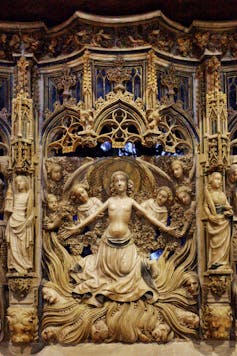
Thecla gains entry to the prison by trading her bracelets and sits with Paul and kisses his chains. During his trial, Thecla is questioned and refuses to answer. Her own mother calls for her to be burned because of her refusal to marry. Thecla is stripped naked and placed on a pyre, but no flames touch her. A miraculous storm erupts, the fire is extinguished, and Thecla survives.
Afterward, she cuts off her hair and dresses as a man in order to follow Paul in disguise. Thecla also asks that he baptize her. Paul asks instead that she have patience and takes her to the city of Antioch.
Thecla’s beauty attracts unwanted attention there, and a man named Alexander immediately falls in love with her. Rather than come to Thecla’s aid, Paul denies knowing her, and Alexander attempts to rape her. Thecla humiliates him by ripping his robe and tearing the wreath off his head. Alexander brings her to the governor of Antioch, who condemns her to face the beasts in the arena.
R. Huggins/IslandsEnd via Wikimedia Commons, CC BY
The scene is terrifying and vivid. Thecla is stripped naked and thrown into the arena, where lions and bears are waiting to attack her. But a lioness walks over to Thecla, lies at her feet and protects her from the other animals.
In the midst of this danger, Thecla stands, reaches out her hands and prays to God. When she opens her eyes, she sees a pool of water filled with killer seals, yet throws herself in to baptize herself. Immediately after, lightning strikes and the seals are killed.
The governor finally releases Thecla and provides her with clothes. She goes immediately to Paul, who finally blesses her and commissions her to teach the gospel.
Women preaching
Many Christians in the ancient world viewed Thecla as an inspiration and an example for leadership. Yet not everyone approved of women teaching and preaching, including a second-century church father named Tertullian. He discouraged Christians from reading the Acts of Thecla and claimed that it was a forgery, since he did not think Paul – who wrote that women should be silent in church – would affirm a woman’s right to teach and baptize.
Tertullian’s warnings reflect controversies surrounding women’s leadership and imply that some women claimed Thecla’s example as justification for preaching.
Later Christians remembered Thecla through artwork as well as texts. For example, a fresco of Thecla – along with her mother and Paul – is depicted in a fifth- or sixth-century grotto just outside of Ephesus, an important city both in the Roman Empire and in early Christianity. The painter imagined Thecla looking out her window, just as the beginning of the Acts of Thecla describes.
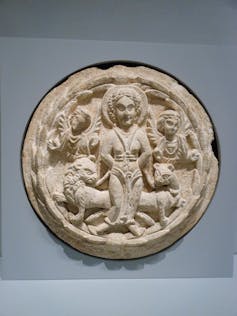
In Egypt, a round, carved plate was discovered depicting Thecla with the lions at her feet. This fifth-century artistic depiction demonstrates how far the story of Thecla’s perseverance in the arena with the beasts had spread.
Ferran Llorens/Flickr via Wikimedia Commons, CC BY-SA
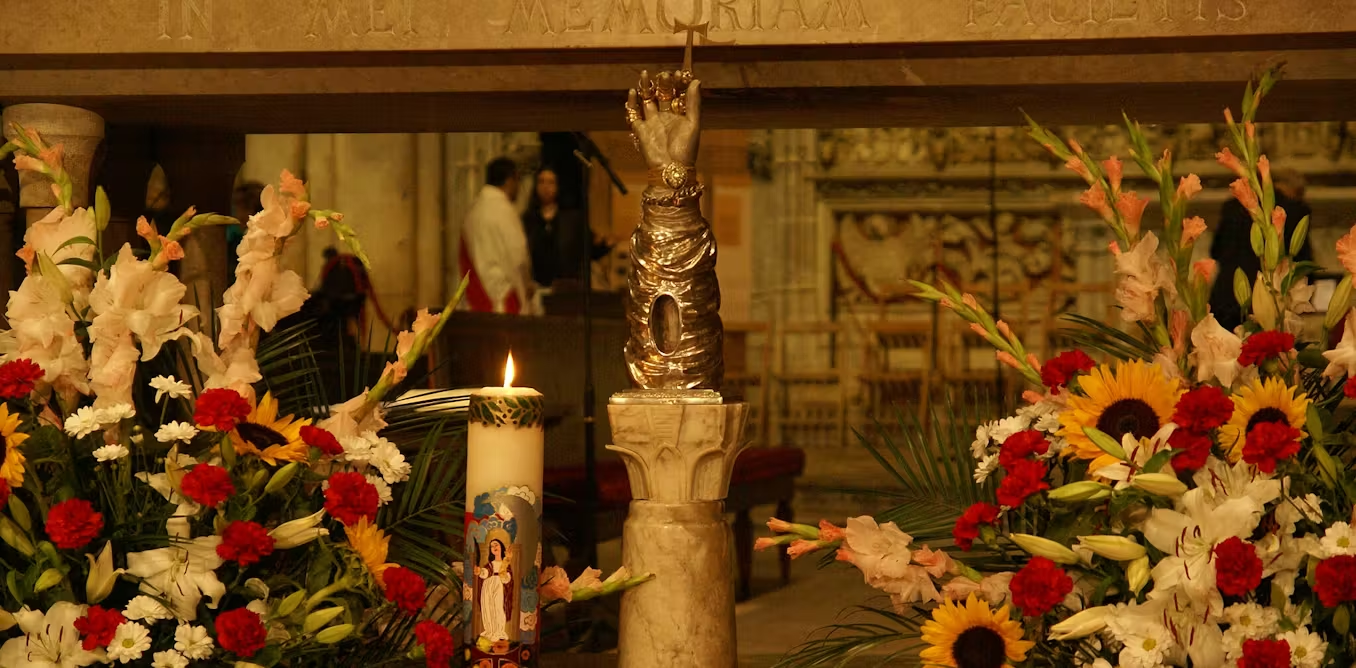
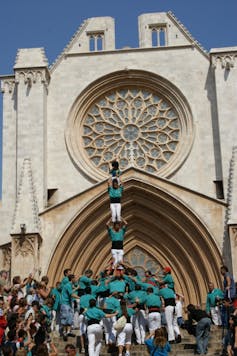
Today, Thecla is the patron saint of the city of Tarragona, Spain, where the cathedral is named after her and images of Thecla decorate the altarpiece. Each year on Sept. 23, the feast day of St. Thecla, this Spanish city celebrates her story through parades, music, dancing and human towers called “castells.” A relic of her arm is processed through the city and displayed in the cathedral so that devotees can view it and pray for blessings.
Just as Thecla listened through her open window to Paul’s message, today Thecla’s story echoes to those who desire to hear the stories of courageous early Christian women.