
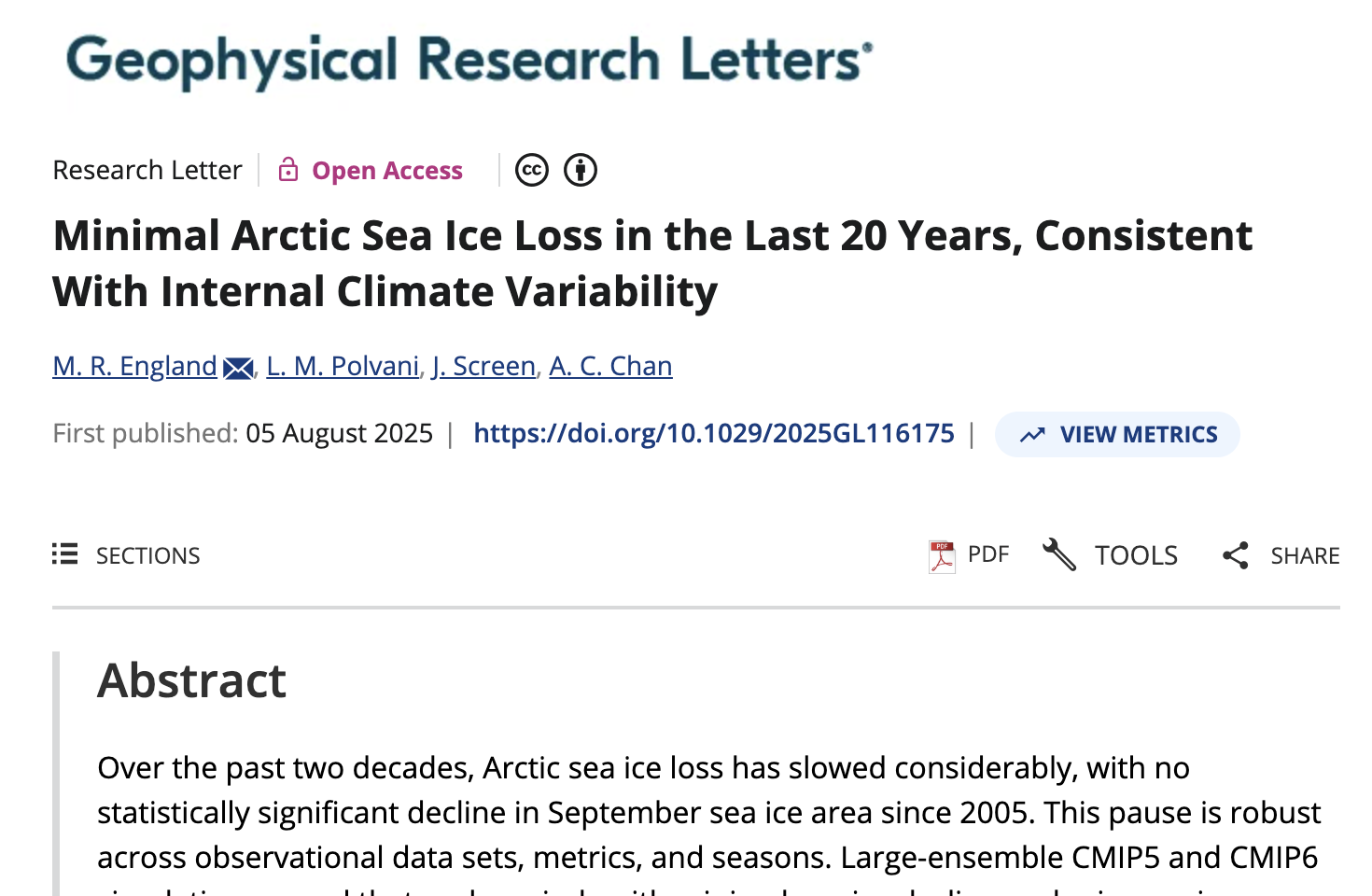
New Examine: ‘Minimal Arctic Sea Ice Loss in the Last 20 Years’ – ‘Arctic sea ice loss has slowed considerably, with no statistically significant decline in September sea ice area since 2005’ – No decline discovered ‘across all months of the year’
Over the last 20 years, the decline of Arctic sea ice has slowed down substantially. Climate models (from CMIP5 and CMIP6) show that pauses in sea ice loss across multiple decades can happen, even as greenhouse gas emissions continue to rise. When we compare the current slowdown to similar pauses in model simulations, we see that it could plausibly continue for another five to 10 years, although the same slowdown makes a faster-than-average sea ice decline more likely in the coming years. Most of the evidence from these climate models suggests that natural climate variations have played a large part in slowing the human-driven loss of sea ice. However, it is not entirely certain whether changes in the human influence on climate (the “forced response”) have also contributed. Overall, while it may sound surprising that Arctic sea ice loss has slowed down even as global temperatures hit record highs, the climate modeling evidence suggests we should expect periods like this to occur somewhat frequently.