
Electrical automobiles trigger stress within the automotive aftermarket
“We’re not against EVs; we just think that all technology should move forward,” Spagnola added. “We’re environmentally respectful—we do a lot of work with CARB and the EPA—but we think technology should move forward, and you should have a choice of what you drive.” Indeed, SEMA has an emissions lab in Diamond Bar, California, to help its member companies create a wide range of products that meet stringent CARB-level requirements.
On one hand, not giving American consumers the choice is counter to how our economy functions, and it limits technological progress. If there are benefits to be found, they typically are found no matter what, especially in the name of horsepower, chassis development, and so on. But on the other hand, stricter guidelines also breed innovation. Increasing emissions and fuel economy standards have gotten us to a level of internal combustion technology that we could have only dreamed of 30 years ago. Who’s to say the same wouldn’t happen with stricter requirements for electrification?
Talking about torque
After speaking with Spagnola and Bailey-Chapman, I ventured over to SEMA’s FutureTech Studio, where a handful of EV-centric companies were highlighted. Two immediately piqued my interest.
The Sierra Echo
Peter Nelson
The Sierra Echo
Peter Nelson
The Sierra Echo
Peter Nelson
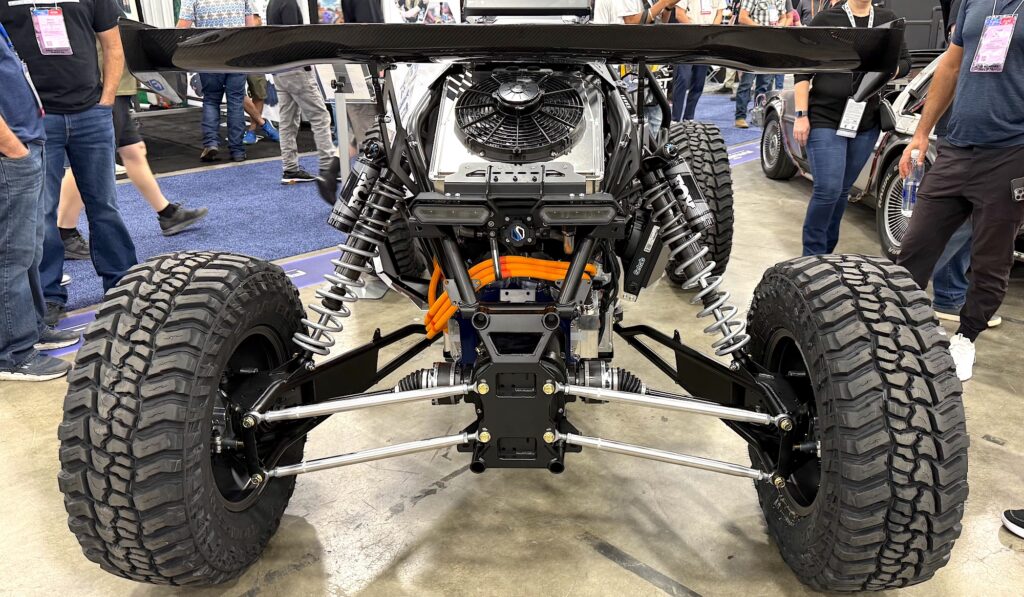
The first was Sierra, a company that specializes in customizable single-seater off-road chassis, including its assemble-it-yourself Echo, which uses an EV powertrain. The benefits of an EV powertrain are immediately noticeable in its packaging. The motor and battery sit far inboard from the rear axle, and due to their compact overall combined dimension, give it small dimensions that would be hard to match with any engine, transmission, and fuel tank.
But the real benefits are found elsewhere. “The biggest thing is torque application,” a company representative told me. “When you’re in off-road racing, going through whoops [and other trail features], I can get all the torque out of that motor instantaneously.” He also highlighted that there are just four moving parts instead of around 400 in an internal combustion-powered rig, so durability is less of a concern. To keep temperatures in check, it sports an active cooling system that flows glycol through the motor and high-velocity fans for the electronics. The application is intended for short-course desert racing that’s less than 200 miles (321 km), in addition to just going for a rip in the dirt.