
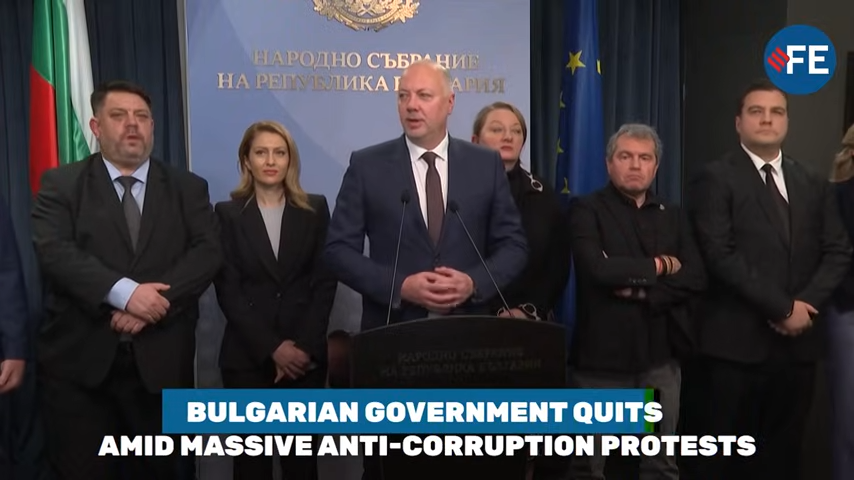
Resignation Of Bulgarian Prime Minister Rosen Zhelyazkov Amidst Mounting Political And Social Disaster – The Balkan
Please Follow us on Gab, Minds, Telegram, Rumble, GETTR, Truth Social, Twitter, and Facebook, Youtube
Rosen Zhelyazkov’s resignation on December 11, 2025, just minutes before the Bulgarian parliament was due to vote on the sixth no-confidence motion against his cabinet, marks the abrupt end of yet another short-lived government in a country that has now been trapped in near-permanent political crisis for more than five years.
The immediate trigger was a wave of nationwide protests that began in late November over the government’s draft 2026 budget – the first to be presented in euros ahead of the country’s scheduled entry into the eurozone on January 1, 2026. What started as anger over proposed increases in dividend taxes and social-security contributions quickly morphed into a broader, visceral rejection of systemic corruption, oligarchic capture, and the perceived arrogance of the political class. Within days, tens of thousands of people – students, pensioners, ethnic Bulgarians and Turks alike – were filling the streets of Sofia, Plovdiv, Varna and smaller towns. The scale and diversity of the crowds were striking in a country of fewer than seven million inhabitants.
Zhelyazkov’s cabinet, formed in early 2025 after the October 2024 parliamentary election, was always fragile. It rested on a minority coalition dominated by GERB (the party of longtime strongman Boyko Borissov) and tolerated, rather than actively supported, by the Movement for Rights and Freedoms (DPS) and figures close to the sanctioned media magnate Delyan Peevski. From the outset, the government was dogged by the same accusations that have haunted every administration since the great anti-corruption protests of summer 2020: that it served narrow elite interests while ordinary citizens continued to suffer from the EU’s highest poverty rate, lowest wages, and most entrenched corruption.
The current crisis is only the latest chapter in a grinding cycle. Since Borissov’s fall in 2020–2021, Bulgaria has held seven parliamentary elections and seen six prime ministers come and go, none of whom lasted a full term. Each collapse has followed the same pattern: a shaky coalition, mutual recriminations, a no-confidence vote or the withdrawal of informal support, and then fresh elections that reproduce the same fragmented parliament. Public trust in institutions has collapsed to the low teens, and the country’s chronic inability to form stable governments has repeatedly delayed or jeopardised key strategic goals – Schengen membership (finally achieved in 2024), euro adoption, and the disbursement of billions in EU recovery funds.
By resigning before the vote, Zhelyazkov denied the opposition the symbolic victory of toppling him in parliament while simultaneously acknowledging that his government had lost all legitimacy in the streets. In his televised address he spoke of “responsibility” and of listening to the “voice for values” coming from the squares. Behind the careful wording, however, lay a stark reality: the coalition had simply run out of options.
Under the Bulgarian constitution, President Rumen Radev – a frequent critic of GERB and often accused of pro-Russian sympathies – will now hand exploratory mandates to the largest parliamentary groups in sequence. Given the depth of mutual distrust among the main parties, the chances of a new regular government emerging within the National Assembly are considered extremely low. Most observers expect the process to fail, leading to the appointment of yet another caretaker cabinet and, almost certainly, the eighth parliamentary election since 2021, possibly as early as spring 2026.
The timing could hardly be worse. Bulgaria is less than three weeks away from adopting the euro, a step that requires not only technical readiness (which has been achieved) but also sustained political stability and public confidence. Prolonged turmoil risks reigniting inflation fears, unsettling investors, and giving fresh ammunition to the nationalist and Eurosceptic parties – particularly Vazrazhdane – that have steadily gained ground amid the chaos.
In the longer view, Zhelyazkov’s fall is less a turning point than another painful reminder of how deeply dysfunctional Bulgaria’s political system has become. The massive protests of 2020 briefly raised hopes that sustained civic pressure could force genuine reform. Instead, the old networks have repeatedly reasserted themselves, reformist parties have fragmented, and voters have grown exhausted. Until a coalition-building becomes possible without the perpetual shadow of oligarchic influence and mutual vetoes, the country is likely to remain locked in the same exhausting loop: protest, collapse, elections, repetition.
For now, the squares have won a tactical victory, but the underlying disease – a political class unable to renew itself and a society that no longer willing to tolerate it – remains untreated.