
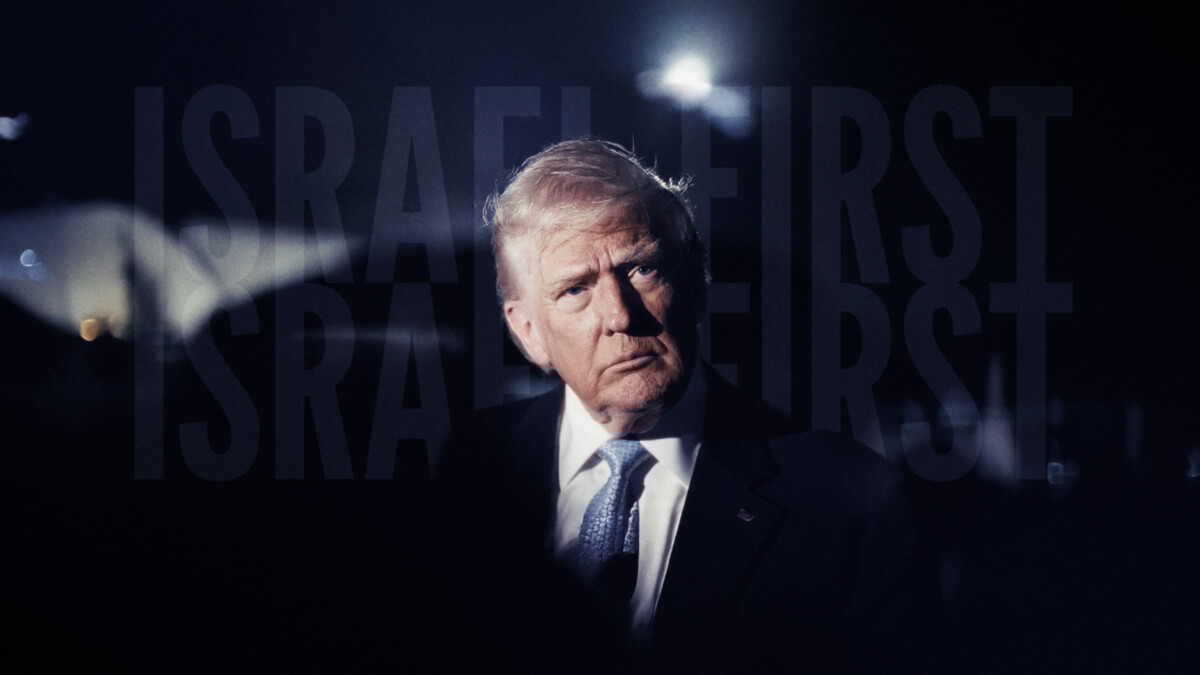
Trump’s Israel-First Presidency Accelerates Zionist Agenda at America’s Expense
Donald Trump’s presidency marked a seismic shift in U.S.-Israel relations, far surpassing the policies of any prior administration in its explicit support and acceleration of Israeli geopolitical objectives.
This transformation, which has been described as “Judeo-Accelerationism,” refers to the rapid and radical advancement of Israeli interests through American power, abandoning the tepid incrementalism of previous presidencies in favor of sweeping actions with lasting repercussions.
Breaking Diplomatic Norms: Jerusalem and the Golan
In 2018, the Trump administration made the most undeniable symbolic move: transferring the U.S. embassy from Tel Aviv to Jerusalem, a city whose status has long been the linchpin of Israeli-Palestinian conflict. Unlike his predecessors who deferred this relocation out of concern for peace efforts, Trump deliberately timed the embassy’s opening to coincide with Israel’s 70th anniversary. This move broke international consensus and was followed by lethal Israeli force against Palestinian protesters in Gaza. The act wasn’t just a diplomatic gesture — it was a signal that the United States would rubber-stamp Israeli claims, regardless of international law or peace prospects.
In 2019, Trump extended this pattern by recognizing Israeli sovereignty over the occupied Golan Heights. This territory had been annexed decades earlier but never officially recognized by the international community until Trump. The timing — just before Israeli elections — underscored the political motivation, boosting Netanyahu and signaling that territorial seizure via force would be condoned by Washington.
Dismantling the Two-State Framework
Trump’s administration abandoned the long-standing U.S. commitment to a two-state solution. Jared Kushner bluntly dismissed the phrase in 2019, acknowledging its irrelevance to Israeli or Palestinian aspirations. The Trump’s “peace plan” instead envisioned fragmented Palestinian enclaves, or bantustans, while allowing Israel formal annexation of about 30% of the West Bank — a plan the Palestinians rightly rejected.
Secretary of State Mike Pompeo’s 2019 declaration that Israeli settlements were “not inherently illegal” represented a stark departure from decades of U.S. policy and international law norms. This “Pompeo Doctrine” effectively legitimized settlement expansion, an obstacle long recognized as deadly to any peace process. Trump’s Abraham Accords further undermined Palestinian leverage by normalizing Arab states’ relations with Israel without securing Palestinian concessions, marginalizing hopes for a viable Palestinian state and contributing to the desperation culminating in the October 7, 2023, Hamas attack.
Iran: The Frontline Proxy
Trump’s hardline stance on Iran was central to his accelerationist agenda. Pre-dating his presidential run, Trump declared Iran’s nuclear ambitions must be stopped “by any and all means necessary”. His withdrawal from the JCPOA in 2018 triggered a “maximum pressure” sanctions campaign aiming to cripple Iran’s economy and force regime capitulation. The sanctions extended aggressively to Iran’s central bank and Supreme Leader Ali Khamenei’s inner circle, marking a confrontationalness unmatched by previous administrations.
The assassination of General Qassem Soleimani in 2020 by a U.S. drone strike brought relations to the precipice of war and embodied Trump’s willingness to use lethal force to defend Israeli interests. Despite warnings from military leaders like Chairman of the Joint Chiefs about the risks of full war, Trump’s administration prepared and launched strikes on Iranian nuclear facilities in 2025, heralding a new phase of regional confrontation. Although these strikes reportedly failed to fully disable Iran’s nuclear program, they signaled an irreversible commitment to an aggressive posture aligned with Israeli security priorities.
Transferring Gaza and Policing Dissent
Domestically, Trump’s policies reinforced this paradigm. His 2025 executive order to “Combat Anti-Semitism” gave authorities power to suppress pro-Palestinian activism on campuses and deport foreign students involved in such causes. This represented an unprecedented use of federal power to silence political dissent that was seen as critical of Israel.
Trump himself floated the idea of forcibly relocating Gaza’s 2 million Palestinians to Egypt and Jordan, describing the territory as a problem to be “cleaned out.” He further suggested that the U.S. might take over Gaza in the future and transform it into a lavish tourist zone—a manifest example of treating Palestinian lives and land as expendable in pursuit of Israeli priorities.
Financing and Staffing the Israel First Agenda
Behind these policies stood an infrastructure of political and financial support. Pro-Israel interests, notably Miriam Adelson’s Preserve America PAC, contributed over $215 million to Trump since 2020. This bloc softened opposition among neoconservatives and helped cement an administration that elevated figures who openly supported the most extreme elements of Israeli policy.
Ambassadors like David Friedman and Mike Huckabee championed settlement expansion and even contemplated population transfer of Palestinians — long considered a toxic fringe idea before becoming normalized under Trump. The administration’s alignment with these viewpoints institutionalized the agenda within the highest levels of U.S. government.
The Enduring Legacy: America Last, Israel First
What differentiates Trump’s presidency is not just individual policies but their cumulative normalization of a radical realignment. By shattering norms on Jerusalem’s status, settlements, annexation, and population displacement, Trump created irreversible facts on the ground that future leaders will find nearly impossible to undo.
This administration discarded multilateral diplomacy and international law, becoming a blunt instrument for Israeli expansionism. While earlier presidents pursued diplomacy — even with flawed results — Trump pursued dominance in service of a foreign power’s aims, often at American expense.
Despite campaigning on “America First,” his record reveals a stark inversion: American resources, soldiers, and diplomatic capital have been expended to guarantee Israel’s regional hegemony, no matter the cost to U.S. credibility, regional stability, or human life.
Trump’s “Judeo-Accelerationist” presidency marks a break from tradition with far-reaching consequences that will echo for decades, forging an uncritical U.S.-Israel alliance as a defining feature of contemporary American foreign policy.