
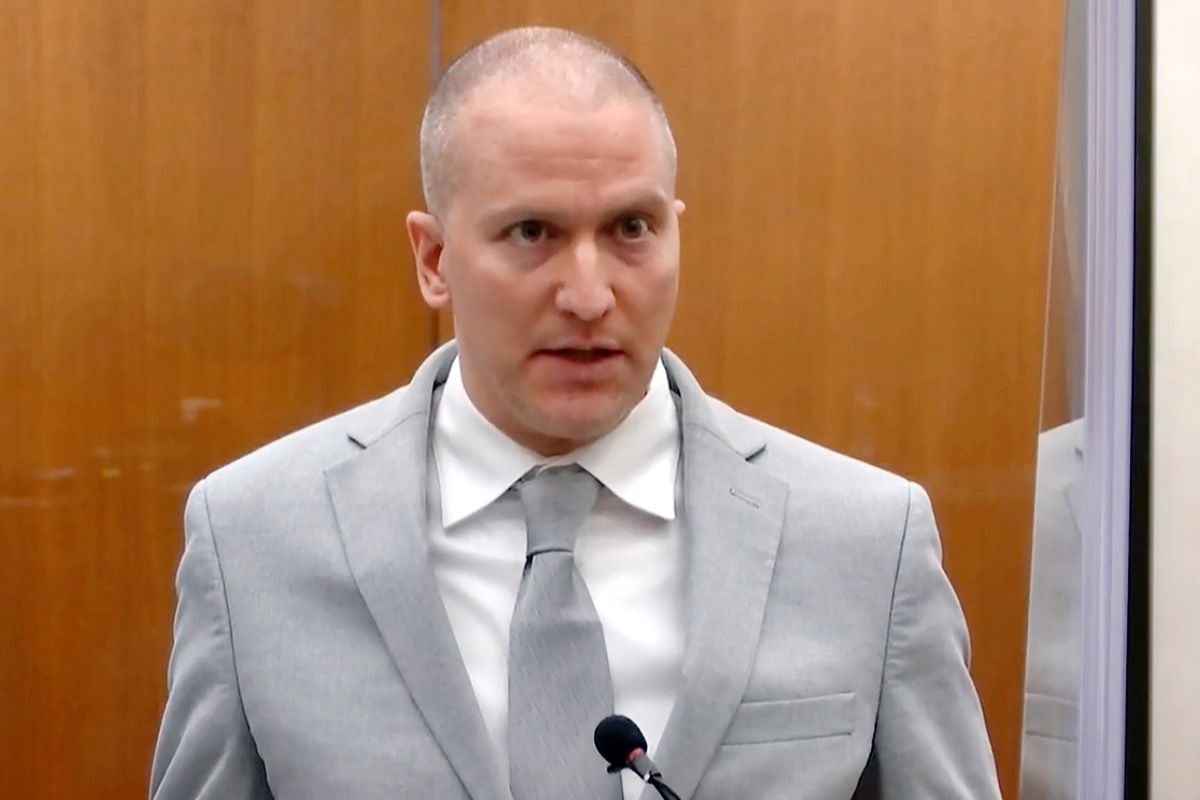
Will Derek Chauvin Be Freed? There’s Now a Critical Problem to the Ex-cop’s Conviction
Alfred Dreyfus, Leo Frank, the Scottsboro Boys, Stefan Kiszko — legion are the cases of men being wrongly convicted, then exonerated. And now a question arises:
Will the case of ex-cop Derek Chauvin, found guilty in 2021 of killing criminal George Floyd, someday be among them?
The answer will be yes if attorney Greg Joseph, who’s now representing Chauvin, has his way. Joseph filed a “Memorandum in support of petition for postconviction relief” on November 20 for the former officer. He’s seeking to vacate Chauvin’s conviction and obtain a new trial.
Joseph’s filing “challenges what he describes as abusive prosecutorial conduct and the presentation of misleading or false testimony during Chauvin’s trial,” reported commentator John Dale Dunn, M.D. on Sunday. Among the bombshells, reported Alpha News recently, is that
50 former and current officers provided sworn declarations stating that the technique used by Derek Chauvin was part of MPD [Minneapolis Police Department] training.
This is significant because central to the case against the officer is that he used an illegal restraint on Floyd.
Anatomy of a Railroading?
In a way, Floyd’s 2020 death was five summers and a thousand years ago. Prevailing at the time was a sort of mass formation psychosis, a mob mentality. Much of the country, liberal Minneapolis in particular, believed that an oppressive police jackboot was on black America’s neck. And Officer Chauvin, in that now-infamous picture restraining Floyd with knee on neck, appeared to embody this. A pound of flesh was demanded.
It’s hard to imagine Chauvin getting a fair trial in this emotionally charged environment and, contends Joseph, he didn’t. As Alpha News informs:
In the 71-page petition filed in Hennepin County District Court, Joseph stated that “this case simply never made sense.” Among several key arguments, he pointed out how few murders “take place before a crowd of witnesses” while officers are working with dispatchers and requesting an ambulance and emergency response.
… Joseph also pointed out key facts — and raised questions about how video evidence was used during the trial. He also underscored the “potential for misuse” of video evidence and the “devastating effect” that false testimony can have in court and the judicial process.
The petition states that the case involved two key issues: intent and causation. That is, one, whether the restraint of Floyd followed policies and procedures of the Minneapolis Police Department (MPD); and two, if the restraint caused his death.
With regard to intent and causation, Joseph stated in the petition that Chauvin’s conviction rested on these “two thin strands.”
In seeking to vacate Chauvin’s conviction, or obtain a new trial, the petition argues that Chauvin “was deprived of his right to due process under the Fourteenth Amendment of the U.S. Constitution and Article I of the Minnesota Constitution.”
The Lonely Facts
So, first, what caused Floyd’s death? The aforementioned Dr. Dunn, who’s also a 40-year attorney, has often addressed this. While he says that claims the criminal died of a drug overdose aren’t actually plausible, something else is. As Dunn wrote in a July American Thinker article:
In my opinion, as a career emergency physician, based on the videos showing events leading to Floyd’s death and the autopsy report, Floyd’s death was not a homicide. Instead, he died suddenly while resisting arrest because he had a cardiac arrest, just as would happen to a man with a bad heart exerting himself while shoveling snow.
Andrew Baker, Hennepin County’s medical examiner, wrote in the original autopsy report that Floyd showed “no life threatening injuries.” In almost all cases, a sudden death with no injuries means a cardiac arrest, as any pathologist knows.
Yet then something happened: The autopsy report “evolved.” As Dunn informed Sunday:
However, as later documented in a November 2020 memo of the state and local prosecutors, Baker changed his position after phone calls from Washington, D.C., pathologist Dr. Roger Mitchell, who warned Baker in two phone calls that he would publicly accuse him of misconduct unless neck compression appeared in the autopsy report. (See my discussion here.) Within days, the final autopsy did include “neck compression.”
This convenient change was coerced because, as Dunn wrote in 2021, without
a diagnosis of asphyxia, the State could not prosecute the officers for murder. That is why Dr. Roger Mitchell was so critical in this tale of intimidation — and why this exhibit memorandum is so important. It reveals a naked attempt by Roger Mitchell to bully Dr. Baker into a conclusion that would enable a second-degree murder prosecution of the police officers [three other cops were also convicted in the Floyd affair]. [Emphasis in original.]
Illegal Restraint — or Lack of Prosecutorial Restraint?
And what of that technique Chauvin used to restrain Floyd? Aside from the 50 officers swearing it was legal and prescribed, Dunn told us Sunday that
Joseph’s petition also details testimony from MPD officials. Joseph argues that this testimony falsely claimed the restraint used on Floyd was neither taught nor approved under MPD policy. I was aware these statements were untrue in 2021 because I had personally reviewed the MPD training manual, which included exactly these restraints. Copies of the manual were publicly visible during the trial…. Both prosecutors and Judge [Peter] Cahill [who presided over Chauvin’s trial] knew the manual’s contents, yet permitted testimony that contradicted it.
A major development occurred in 2024, when District Judge [Edward] Wahl dismissed former MPD training official Katie Blackwell’s defamation lawsuit against Alpha News and its reporters for challenging the accuracy of his [sic] testimony. Defense attorney Chris Madel submitted extensive affidavits and evidence demonstrating that Blackwell’s prior statements about the restraint method were false.
Judge Wahl didn’t stop with ruling in Alpha News’s favor. He also dismissed the case with prejudice, required Blackwell to acknowledge the inaccuracy of her statements, and ordered her to pay the defendants’ legal fees. This outcome strongly reinforces the claim that Blackwell’s testimony should not have been relied on during Chauvin’s trial, and that any other testimony in line with hers was inaccurate, too, as well as being incredibly harmful to Chauvin’s case.
A Travesty
Dr. Dunn, who has worked in emergency medicine since 1974, is convinced Derek Chauvin did not kill George Floyd. He knows the neck’s structures and states that the officer’s restraint could not have caused death. Dunn has even recreated the scenario — with himself in Floyd’s place and a 220-pound man applying the knee. Dunn’s oxygen levels were measured during this test and never went below 95 percent.
More could be said on the case, too. And for that I suggest you read Dr. Dunn’s exhaustive articles on the subject (found here).
The bottom line, however, is that justice was apparently not served in the Floyd case. Instead, with passion governing unwisely, a pound of flesh just might’ve been served up to a braying mob.