
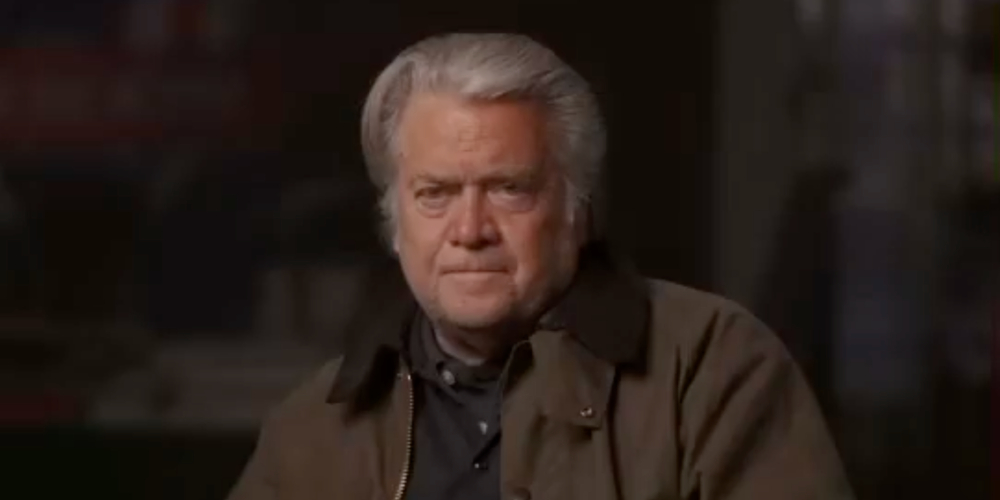
EXCLUSIVE: Steve Bannon petitions Supreme Courtroom to overturn J6 Committee conviction citing govt privilege
“Petitioner—a former executive branch official—relied in good faith on his attorney’s advice to delay compliance with a subpoena issued by a House Select Committee until executive privilege disputes were first resolved.”
Steve Bannon has petitioned the Supreme Court to overturn his contempt of Congress conviction that saw the former Trump administration official and War Room host spend four months in prison. Bannon had been subpoenaed by the House select committee investigating January 6, however, the information sought was initially protected under executive privilege. After Trump revoked that privilege, and Bannon was able to respond to the committee, he was indicted and later sentenced.
The petition for a writ of certiorari filed in the nation’s highest court centers around Section 192 of Title 2, which states, “Every person who having been summoned as a witness by the authority of either House of Congress to give testimony or to produce papers upon any matter under inquiry before either House, or any joint committee established by a joint or concurrent resolution of the two Houses of Congress or any committee of either House of Congress, willfully makes default, or who, having appeared, refuses to answer any question pertinent to the question under inquiry, shall be deemed guilty of a misdemeanor, punishable by a fine of not more than $1,000 nor less than $100 and imprisonment in a common jail for not less than one month nor more than twelve months.”
The first question being asked of the Supreme Court is whether “willfully,” as presented in Section 192, “requires the government to prove the defendant knew his conduct was unlawful.”
The petition states that the DC Circuit had interpreted “willfully” as meaning “to require only intentional conduct, meaning the government need not prove the recipient knew his conduct was unlawful.” The petition later added that the Supreme Court “has long held that in the criminal context, ‘to prove “willfulness,” the Government must demonstrate that an individual knew that his conduct was unlawful,'” and that “it appears that is the uniform practice of this Court when interpreting criminal statutes.”
“The proper mens rea was critical here because Petitioner—a former executive branch official—relied in good faith on his attorney’s advice to delay compliance with a subpoena issued by a House Select Committee until executive privilege disputes were first resolved, as they had been on three prior occasions involving the Petitioner’s testimony.”
Bannon was advised that he had been “acting in accordance with the law,” however, he was indicted under Section 192 and the District Court “reluctantly concluded the DC Circuit’s decision in Licavoli v United States barred Petitioner from presenting any evidence or argument to the jury regarding his reliance on his lawyer’s advice or on executive privilege.” That case ruled that willfully means “intentionally.”
“Precedent, text, structure, and the separation of powers thus all point in the same direction: the DC Circuit’s interpretation of ‘willfully’ in Section 192 is grievously wrong. That issue is eminently worthy of review and correction.”
The petition also asks the court to weigh the question of whether “the proper composition of a congressional committee bears on its ‘authority’ to issue a subpoena for the purposes of 2 USC Section 192.” The subpoena was issued to Bannon by the House Select Committee to Investigate the January 6th Attack on the United States Capitol, chaired by Rep Bennie Thompson.
“Section 192 requires the relevant subpoena to have been issued pursuant to the House or Senate’s ‘authority,’ but it is undisputed that the committee that issued the subpoena here was never properly constituted in accordance with the House Resolution creating the committee. That means there was no ‘clear chain of authority from the House to the [committee],’ which defeats ‘an essential element’ of Section 192, ie, the subpoena was not lawfully authorized.”
Under House Resolution 503, which created the select committee, committees “shall” have 13 members, five of which “chosen in consultation with the minority member.” The resolution also “authorized the committee to issue subpoenas only after consultation with the ranking minority member.”
The House filed a brief at the DC Circuit Court acknowledging that “the Speaker had a nondiscretionary duty to appoint 13 Members to the Select Committee. And she should have appointed five Members of the minority party after consulting with the ranking minority member. House Resolution 503 likewise required the Chairman to consult with the ranking minority member before issuing any subpoena. In this House’s view, none of these things happened.”
A lower court declined to hear that argument, calling it a “procedural objection” that needed to be raised with the committee itself, the petition stated. The filing later added, “This Court has repeatedly granted certiorari to address when congressional subpoena recipients must preserve arguments before the relevant committee in the Section 192 context. The Court should grant review again to affirm that the prosecution must prove a valid and direct line of authority from the House to the committee that purported to issue the relevant subpoena.”
Bannon Petition for Writ of Certiorari by Hannah Nightingale