
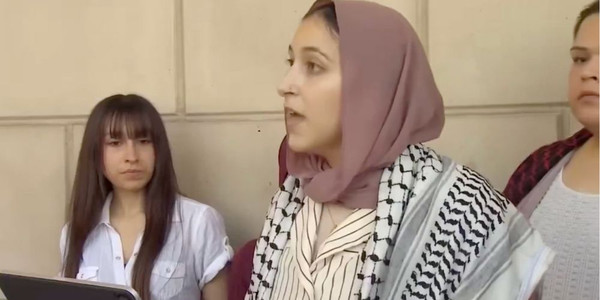
CAIR defends Muslims who graffitied Texas Church, claims it was protected speech
“We can and should condemn the vandalism of a house of worship without criminalizing speech.”
The Council on American-Islamic Relations (CAIR) has argued that prosecutors drop charges against three Muslims accused of vandalizing a Texas church, arguing the act was political expression protected by the First Amendment.
In 2024, three individuals were charged in connection with graffiti spray-painted on the wall of a non-denominational church in Euless, Texas. The act of vandalism was carried out after the church raised an Israeli flag following Hamas’ October 7, 2023, terrorist attack on Israel. The phrase “F*** Israel” was painted on the walls of the church along with pro-Palestinian stickers, all of which were captured on the church’s security cameras.
Three suspects, identified as Raqunaq Alam, Asfsheen Khan, and Julia Venzor, were initially charged with felony criminal mischief, but the charges were later increased to a third-degree felony hate crime because they targeted a church.
Alam was tried in September and convicted of criminal mischief but acquitted of the hate crime charge. He was sentenced to five years of probation, ordered to pay a $10,000 fine, and required to pay $1,700 in restitution to the church. Judge Biran Bolton added 180 days of incarceration to Alam’s sentence, calling the graffiti “disgusting,” according to The Guardian.
Venzor agreed to testify against Alam and Khan in exchange for a plea deal that included five years of probation. Khan’s trial is expected in the fall.
Ahead of the trials, CAIR-Texas urged Tarrant County prosecutors to drop the hate crime enhancements, calling them an overreach of the law.
“Although we strongly condemn the vandalism of this church and believe that those responsible should be held accountable for this crime, Texas prosecutors are going beyond the law attempting to criminalize political speech by conflating criticism of the Israeli government with religious hatred,” said Mustafaa Carroll, Executive Director of CAIR-Texas DFW. “Our state’s hate crime laws were meant to protect vulnerable communities, not shield foreign governments from critique. We can and should condemn the vandalism of a house of worship without criminalizing speech.”
Defense attorney Alison Grinter-Allen defended the defendants’ actions as a form of expression, saying that graffiti is “the language of folks who are unheard.”