
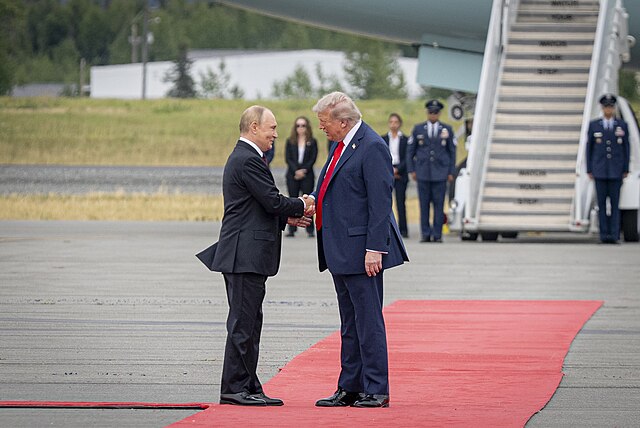
The Trump-Putin Meeting And The Search For Peace – JP
Public Domain
Please Follow us on Gab, Minds, Telegram, Rumble,Truth Social, Gettr, X , Youtube
Predictions and calculations in international relations are extremely difficult due to the high degree of contingency that is based on unpredictable human nature. For those who have been active in politics or are still active, they know that a summit meeting does not happen, unless something has already been agreed upon or if some things need to be discussed more seriously in person, not through mediators and negotiators. The meeting between the American and Russian presidents in Alaska can be viewed in this context.
For months now, US-Russian negotiations have been going on secretly, and sometimes openly, around the world, with Ukraine being just one of the items on the agenda of these negotiations. Before President Donald Trump, which was emphasized at the meeting, American-Russian relations were at their lowest level since the Cold War, and it was necessary to solve numerous bilateral problems, such as the work of diplomatic missions, but also to try to understand (and explain) Russian and American interests and positions regarding conflicts and crises around the world. Months of diplomatic work resulted in an almost three-hour summit meeting between the Russian and American delegations.
After the meeting in Alaska, the main result of the negotiations is very clear — the return of Russia from the isolation of the West, and this happened on American soil. This scenario probably sounded unreal to many until it happened, which only shows the levels of unpredictability and contingency in international relations. Also, the key thing is that the American anti-Russian sanctions against secondary actors (India and China) have been postponed.
This meeting can be seen as an act of signaling to third parties, rather than a direct mechanism for conflict resolution. In negotiations, key information is often conveyed not through direct agreement, but through deliberate gestures, choice of language and symbolic moves that serve to shape the expectations of other states and the international public. In this sense, the meeting between the American and Russian presidents in Alaska can be interpreted as an example of a communication signal directed towards Europe, China, and even the global South – a message that both powers, despite conflicts and mismatched interests, remain capable and willing for direct dialogue.
Speaking of symbols, just a brief reflection on the t-shirt with the symbolic inscription USSR (Russian: CCCP) of Russian Foreign Minister Sergei Lavrov. Interpretations are different, but looking contextually, it happened in the USA, where the Monroe Doctrine prevails (restriction of European influence in America or America to Americans), Lavrov only reminded of the Russian version of the Monroe Doctrine better known as the Kozirev Doctrine from 1992/1993. which says that Russia’s immediate neighborhood (states of the former USSR) is Russia’s sphere of influence. I remind you that the first Minister of Foreign Affairs of the Russian Federation, Andrey Vladimirovich Koziriev, was Yeltsin’s liberal pro-Western cadre who advocated closer cooperation between Russia and the USA and NATO, so Koziriev probably looked up to American geopolitical ideas such as the Monroe Doctrine and the famous Manifest Destiny, which Sergei Lavrov only reminded of.
It will be interesting to see, once the Russian-Ukrainian conflict comes to an end, whether Russia will play the game that Ukraine should have played through a foreign policy balancing strategy, only Russia between the USA and China. Ukraine implemented the aforementioned foreign policy strategy from the collapse of the USSR until 2014 and Euromaidan, balancing between the West and Russia. With this foreign policy strategy of balancing between the USA and China, an opportunity opens up for Russia to return from Western isolation, to rise above the sanctions. On the other hand, if no agreement is reached by the Western Allies (US, Europe and Ukraine), Trump could potentially cut off all efforts himself and deliver his peace deal to the Europeans and Ukraine as an ultimatum: either accept this deal or I withdraw from any kind of support for this conflict, and you continue to wage war until final destruction. In President Trump’s speech after the meeting, this is evident when he says that it is up to the Europeans and Ukrainians whether they will accept the peace agreement or not, which shows that Trump himself sees great difficulties in finding an agreement.
Although we may still be far from a final peace agreement, we are moving towards it, which is certainly progress. In the coming time, there will be talks about ending the conflict, and for Russia, apart from the territories, the neutralization and demilitarization of Ukraine, as well as the cultural and linguistic rights of Russians in Ukraine, are equally important points. The question of security guarantees is also crucial, but not only for Ukraine, as many think and which the media constantly reports on, but also for Russia, which will also seek security guarantees for itself that once signed peace agreements do not come into question (as was the case with the Minsk Agreements) or that any party does not dare to launch new attacks on (potentially new, but also old) Russian territories.
The very title of the meeting Pursuing Peace (not ceasefire) shows an understanding of the Russian position, which speaks of peace, not ceasefires, since Russia is on alert after two failed ceasefires from Minsk. Let’s just remember “former German Chancellor Angela Merkel and French President François Hollande, who declared after the start of Russia’s offensive military operations in Ukraine in 2022, that the Minsk Agreements were just buying time for Ukraine to arm itself and prepare for a conflict with Russia. Such a statement is diplomatically and foreign policy extremely dangerous because it is concluded that the agreement was a fraud and an empty letter from the beginning, and for Russia another in a series of betrayals and disappointments from Europe! After such statements by the strongest European countries, Germany and France, which advocate for the promotion and adherence to international law and the signed treaties, with the legal principle of pacta sunt servanda, why should anyone trust them again?
Trump, like Putin, is going immediately for peace, he does not need a new truce, because from the Russian perspective, the truce will be used to arm Ukraine and prepare for military operations again. That is why the position of both Trump and Putin is — let’s end the conflicts, establish peace and start economic, trade and financial cooperation and a new European security architecture (which, paradoxically, many European leaders do not want). Russia is a big market, but also a source of many minerals and raw materials that the USA needs if they want to remain a key world power. Also, there is Russian influence in the Middle East, the Arctic, Central Asia, issues around the Caucasus, Africa and that key issue on which there is great silence — China (but also various other possible topics that were potentially discussed behind closed doors). But the key to these numerous opportunities waiting to be realized, invested and reopened Russia to the world, is Ukraine. The conflict that Donald Trump inherited from Biden (and as Putin repeated: if there was Trump, the conflict would never even have started) and which is extremely complex to end diplomatically, is therefore still continuing on the battlefield.
President Trump’s determination gives hope to the whole world that peace will be negotiated and the war will end this year.